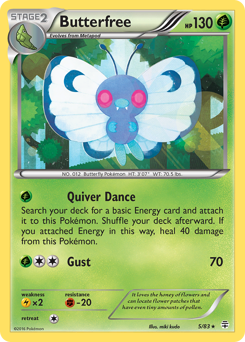
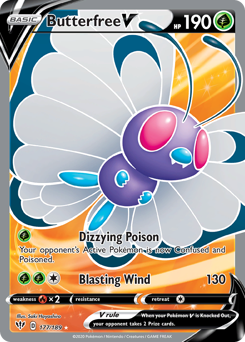
Butterfree (In-Game & Casual)
No,  Butterfree is not good for competitive play or late-game story progression. While its early evolution at level 10 and the Compound Eyes plus Sleep Powder combo make it a fantastic early-game carry, its abysmal base stats and severe typing weaknesses cause it to fall off drastically mid-playthrough.
Verdict
Butterfree shines brightly in the first few hours of a playthrough but lacks the raw stats to survive the late game.
Rating 4.5/10 · Tier D-(Late Game), S-(Early Game) · Role : Early-Game Status Spreader / Setup Sweeper
Strengths
- Evolves fully at level 10, offering an immediate and massive power spike.
- Compound Eyes raises Sleep Powder accuracy to a highly reliable 97%.
- Access to Quiver Dance provides excellent setup potential against passive story opponents.
- Excellent utility for catching wild Pokémon thanks to reliable sleep status.
Weaknesses
- Extremely low base stats across the board, especially physical bulk.
- 4x weakness to Rock-type moves makes it incredibly fragile.
- Severely outclassed by almost every other Bug and Flying type as the game progresses.
- Base Speed is too low to reliably outspeed late-game threats without setup.
Butterfree Base Stats

BEST COUNTERS


SIZE COMPARISON
SPRITE GALLERY
 OFFICIAL ARTWORK
 OFFICIAL SHINY
 HOME 3D
 HOME 3D SHINY
 FRONT
FRONT FRONT SHINY
 BACK
BACK BACK SHINY
 ANIMATED
 ANIMATED SHINY
Tier & Role: The Quintessential Early-Game Carry
Butterfree occupies a very specific niche in Pokémon playthroughs: the early-game crutch. Because  Caterpie evolves into
  Metapod at level 7 and Butterfree at level 10, you gain access to a fully evolved Pokémon before you even face the first gym. This provides a massive, immediate stat advantage over the unevolved wild Pokémon and early trainer rosters you encounter.
Its primary role is a status spreader and early setup sweeper. You do not use Butterfree for raw, immediate damage. Instead, you rely on its utility to control the pace of a battle. By putting threats to sleep, Butterfree buys you free turns to heal your team, set up your own stats, or safely chip away at an opponent's health.
However, this utility has a strict expiration date. Once you reach the mid-game and opposing trainers start using fully evolved Pokémon with higher base stats, Butterfree's early advantage vanishes. Its role transitions from a team carry to a fragile liability that struggles to survive a single neutral physical attack.
The Core Mechanic: Compound Eyes & Sleep Powder
If you are using Butterfree, you are using it for one specific mechanical interaction: the ability Compound Eyes paired with the move Sleep Powder. Compound Eyes boosts the accuracy of all moves by 30%. Sleep Powder normally has a shaky 75% accuracy, making it risky to rely on.
With Compound Eyes, Sleep Powder reaches a 97.5% accuracy rate. This transforms Butterfree into one of the most reliable sleep-inducers in any Pokémon game. You can confidently click Sleep Powder knowing it will almost certainly land, completely shutting down the opponent's active Pokémon.
Enabling Quiver Dance
This reliable sleep status is what allows Butterfree to function offensively. On its own, Butterfree is too slow and frail to safely use Quiver Dance, one of the best setup moves in the franchise. But if the opponent is asleep, Butterfree gets a free turn to boost its Special Attack, Special Defense, and Speed.
After one or two Quiver Dances, Butterfree can temporarily bridge the gap between its poor base stats and the late-game power level. It can then sweep with moves like Bug Buzz and Air Slash. However, this strategy requires setup time, which is not always a luxury you have against aggressive, fast-paced teams.
Best Uses & Matchups (In-Game)
Butterfree excels in utility tasks outside of major boss battles. Its most enduring use is as a catcher Pokémon. When trying to capture rare wild encounters or Legendaries, putting them to sleep significantly increases the catch rate. Butterfree's 97% accurate Sleep Powder makes this process far less frustrating than relying on Hypnosis or Sing.
In early gym battles, Butterfree is exceptionally strong against Grass and Fighting-type gyms. Its Flying typing gives it a resistance to Grass and Fighting moves, while Air Slash provides super-effective STAB (Same Type Attack Bonus) damage. It can easily sweep early bosses who lack coverage moves.
Specific Playthrough Advantages
- Catching Roaming Legendaries: Reliable sleep prevents them from fleeing immediately.
- Bypassing Early Walls: Putting a high-defense early-game Pokémon to sleep allows you to chip it down without taking damage.
- Double Battles: While frail, Butterfree can use Tailwind to double your team's speed or redirect attention with Rage Powder, sacrificing itself to let your main attacker sweep.
Honest Weaknesses: Why It Fails Mid-to-Late Game
Butterfree's base stats are simply too low to compete in the latter half of any Pokémon game. Its HP and Defense are abysmal, meaning any physical attack—even those that are not super effective—will likely knock it out in one hit. You cannot pivot Butterfree into an attack; it must be brought in safely after a teammate faints.
The Bug/Flying typing is notoriously poor defensively. It grants a devastating 4x weakness to Rock-type moves. If Stealth Rock is on the field, Butterfree loses half its maximum HP just by switching in. It also carries weaknesses to common Fire, Electric, and Ice-type attacks, making it incredibly difficult to keep alive.
Speed Issues
Despite being a Flying-type, Butterfree is surprisingly slow. Without a Quiver Dance boost, it will be outsped by the majority of late-game offensive Pokémon. If it cannot strike first with Sleep Powder, it will almost certainly be knocked out before it can act. This over-reliance on acting first with a low base Speed makes it highly inconsistent against Elite Four members or Champion fights.
Avoid If... & Better Alternatives
Do not use Butterfree if you are playing any form of competitive PvP. It is entirely unviable in serious formats because opponents will simply outspeed and OHKO (One-Hit Knockout) it before it can use Sleep Powder. It also requires heavy team support to remove entry hazards, which is not worth the investment for such a low-tier Pokémon.
In a standard playthrough, avoid keeping Butterfree on your team if you already have a fast, dedicated Flying-type or a stronger Bug-type. Once you hit level 30 to 40, the opportunity cost of keeping Butterfree becomes too high. You are essentially playing with a handicap by dedicating a team slot to it.
Superior Alternatives
 Volcarona: The ultimate Quiver Dance user. It boasts vastly superior stats, a better typing (Bug/Fire), and actual competitive viability.
 Togekiss: If you want a Flying-type that flinches opponents to death with Air Slash, Togekiss has the bulk and Special Attack to do it infinitely better.
 Scizor: A Bug-type with phenomenal physical bulk, excellent typing (Bug/Steel), and priority moves that completely bypass Butterfree's speed issues.
 Corviknight: A highly durable Flying/Steel type that can take the physical hits Butterfree instantly crumbles to.
Related Pokémon guides
Explore Competitive Roles
Frequently Asked Questions About Butterfree
Is Butterfree good in competitive PvP?
No. Butterfree lacks the speed, bulk, and typing to survive in serious competitive formats. It is easily outsped and knocked out by almost any common physical attacker before it can utilize its status moves.
What is the best ability for Butterfree?
Compound Eyes is mandatory. It boosts move accuracy by 30%, which raises the accuracy of Sleep Powder from a risky 75% to a highly reliable 97.5%, making it Butterfree's most valuable tool.
When does Caterpie evolve into Butterfree?
Caterpie evolves into Metapod at level 7, and then Metapod evolves into Butterfree at level 10. This extremely early evolution curve is the primary reason Butterfree is so useful in the early stages of a playthrough.
What is a good moveset for Butterfree in the story?
A standard and effective in-game moveset includes Sleep Powder, Quiver Dance, Bug Buzz, and Air Slash. You put the opponent to sleep, boost your stats with Quiver Dance, and sweep with your STAB attacks.
Pokedex.me is an unofficial fan site, not affiliated with Nintendo, Game Freak or The Pokémon Company. Competitive takes reflect observed usage (Smogon SV stats).