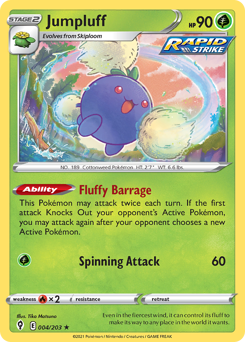
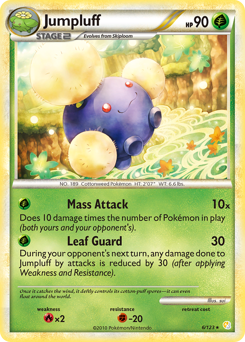
Jumpluff (In-Game & Competitive)
 Jumpluff is situationally good as a fast utility support, but completely unviable for direct offense. In playthroughs, its priority Sleep Powder makes catching Pokémon easy, though its low damage falls off late-game. In competitive play, it completely lacks a presence in standard singles, relegated to fringe disruption roles.
Verdict
Jumpluff trades all offensive pressure for elite speed and priority status, making it a niche enabler rather than a standalone threat.
Rating 5.5/10 · Tier C-(Playthrough) / Untiered (Smogon SV) · Role : Prankster Disruptor / Fast Pivot
Strengths
- Elite Base 110 Speed outpaces many common threats.
- Prankster Hidden Ability grants priority to Sleep Powder and Tailwind.
- Access to U-turn provides excellent pivoting momentum.
- Rage Powder offers valuable redirection in double battles.
Weaknesses
- Abysmal Base 55 Attack and Special Attack make it passive.
 Gholdengo and Grass-types completely wall its status-reliant movepool.
- Extremely frail on the physical side (Base 70 Defense).
- Four-times weak to Ice, alongside four other common weaknesses.
Jumpluff Base Stats & Viability Breakdown

BEST COUNTERS
Effective Pokémon against jumpluff


SIZE COMPARISON
SPRITE GALLERY
 OFFICIAL ARTWORK
 OFFICIAL SHINY
 HOME 3D
 HOME 3D SHINY
 FRONT
FRONT FRONT SHINY
 BACK
BACK BACK SHINY
 ANIMATED
 ANIMATED SHINY
Tier & Role: Unpacking Jumpluff's Niche
Jumpluff occupies a highly specific niche defined entirely by its stat distribution. Its standout feature is a Base 110 Speed stat. This allows it to naturally outspeed crowded speed tiers, including Base 100s like  Palafin and Base 105s like
  Zoroark. Because of this speed, Jumpluff operates primarily as a fast disruptor or pivot.
However, its offensive capabilities are practically non-existent. With Base 55 Attack and Base 55 Special Attack, Jumpluff cannot function as a direct damage dealer. Even with super-effective hits, moves like Giga Drain or Acrobatics fail to secure knockouts against moderately bulky targets. This forces Jumpluff into a pure utility role, relying on status moves to influence the battle.
Defensive Profile and Abilities
Defensively, Jumpluff is a mixed bag. Its Base 75 HP and 70 Defense make it highly vulnerable to physical priority moves like Extreme Speed or Ice Shard. Conversely, its Base 95 Special Defense allows it to survive neutral special attacks, giving it narrow windows to switch in. Its Grass/Flying typing provides useful resistances to Fighting, Water, and Ground, but burdens it with five weaknesses, including a crippling four-times weakness to Ice.
Its viability hinges entirely on its Hidden Ability, Prankster. Prankster grants +1 priority to all status moves, allowing Jumpluff to act before faster opponents. While Chlorophyll exists for sun teams, Prankster is the definitive choice, transforming Jumpluff from a fast but frail liability into a dedicated status spreader and speed controller.
Essential Movesets & Core Battle Strategies
A standard competitive Jumpluff set revolves entirely around disruption and momentum. Sleep Powder is its primary tool. With Prankster, Jumpluff can fire off a priority sleep status, instantly neutralizing a threat. While its 75% accuracy introduces risk, the payoff of completely shutting down an opposing sweeper is often worth it.
Leech Seed pairs naturally with Sleep Powder. Since Jumpluff lacks offensive presence, Leech Seed provides vital passive damage while healing Jumpluff or the teammate it pivots into. Encore is another critical tool in its arsenal. By locking an opponent into a setup move like Swords Dance or a non-damaging status move, Jumpluff forces immediate switches and disrupts the opponent's strategy.
Momentum and Speed Control
To maintain momentum, U-turn is mandatory. After putting a target to sleep or locking them with Encore, Jumpluff can use U-turn to safely bring in a wallbreaker. Because Prankster does not affect U-turn, Jumpluff's natural Base 110 Speed ensures it can still pivot quickly when needed.
In double battles, its movepool shifts slightly. Tailwind becomes a primary focus, providing priority speed control for the entire team. Rage Powder is also highly valuable in VGC formats. By redirecting single-target attacks toward itself, Jumpluff can sacrifice its own HP to ensure a fragile partner, like  Flutter Mane or
  Chi-Yu, survives to execute its strategy.
In-Game Playthrough & Casual Utility (Scarlet/Violet)
For a standard playthrough of Pokémon Scarlet and Violet, Jumpluff offers unique early-game utility.  Hoppip is available immediately in South Province (Area One). Evolving into
  Skiploom at level 18 and Jumpluff at level 27, you gain access to a fully evolved, highly fast Pokémon before tackling the mid-game Gyms. Its natural speed ensures you will almost always move first against NPC trainers.
Its greatest in-game value lies in catching wild Pokémon. Access to Sleep Powder makes capturing high-level targets significantly easier. When exploring Area Zero in the post-game, having a fast Sleep Powder user is invaluable for securing Paradox Pokémon without relying heavily on Ultra Balls. Leech Seed also helps whittle down tougher boss encounters where direct damage isn't enough.
Late-Game Falloff
Despite its early utility, Jumpluff falls off sharply in the late game. As opponent levels scale, its Base 55 offenses become a severe liability. You will find yourself unable to defeat standard NPC teams efficiently. Unlike  Arboliva, which offers massive Special Attack and terrain control, or
  Corviknight, which provides elite physical bulk and damage, Jumpluff slows down the pace of casual battles.
If you need a Grass or Flying type purely to deal damage during the story, Jumpluff is a poor choice. It requires constant switching and status management, which is tedious for standard story progression. Keep it in your party for catching mechanics, but rely on harder-hitting alternatives for major story battles.
Competitive Reality Across Formats (Gen 9)
In standard singles formats, particularly Smogon's Scarlet and Violet tiers, Jumpluff is practically non-existent. It does not appear in standard competitive usage stats for OverUsed (OU), UnderUsed (UU), or even lower tiers like RarelyUsed (RU). It is firmly categorized as Untiered. The current singles metagame is far too hostile for a Pokémon with zero offensive presence and extreme reliance on status moves.
The introduction of Gholdengo in Gen 9 completely invalidates Jumpluff in singles. Gholdengo's Good as Gold ability makes it immune to Sleep Powder, Leech Seed, and Encore. Furthermore, Dark-types are naturally immune to Prankster-boosted moves. A single  Kingambit or
  Meowscarada can switch in for free and use Jumpluff as setup fodder.
VGC and Doubles Niche
Jumpluff fares slightly better in VGC and double battles, though it remains a fringe pick. Its combination of Prankster Tailwind, Sleep Powder, and Rage Powder gives it a specific support profile. Early in the Gen 9 VGC format, it saw minor usage next to  Torkoal. Jumpluff could set Tailwind or redirect attacks while Torkoal fired off sun-boosted Eruptions.
However, even in VGC, it faces stiff competition.  Whimsicott is widely considered the superior Prankster Tailwind setter due to its Fairy typing and access to Moonblast, which prevents it from being completely passive.
  Amoonguss is universally preferred for redirection and sleep status, as its Spore is 100% accurate and its bulk allows it to survive multiple hits. Jumpluff is only chosen when a team desperately needs Tailwind and Rage Powder compressed into a single slot.
Meilleurs usages & matchups
Jumpluff shines brightest when matched against slow, defensive Pokémon or setup sweepers that rely on non-damaging moves. A prime example is its matchup against defensive walls like  Dondozo or Corviknight. If Jumpluff switches in safely, it can use priority Encore to lock them into Protect or Roost, forcing them to switch out and surrender momentum.
It also excels against slow setup sweepers. If an opposing  Dragonite attempts to use Dragon Dance, Jumpluff can survive a neutral hit (or use a Focus Sash) and lock it into Dragon Dance on the following turn with Prankster Encore. This completely halts the opponent's sweep and provides a free turn for Jumpluff's team to pivot.
Ideal Teammates and Synergies
Jumpluff requires teammates that can capitalize on the disruption it causes. Slow, devastating wallbreakers benefit immensely from its support. Ursaluna-Bloodmoon is an excellent partner; Jumpluff can set Tailwind to fix  Ursaluna's poor speed, or use Sleep Powder to give Ursaluna a free turn to fire off Blood Moon.
  Iron Bundle also appreciates Rage Powder support, allowing it to spam Hydro Pump or Freeze-Dry without fear of priority attacks.
Entry hazard setters synergize perfectly with Jumpluff. Because Jumpluff forces so many switches via Leech Seed and Encore, having Stealth Rock or Spikes on the opponent's side of the field racks up significant passive damage.  Glimmora or
  Ting-Lu are excellent partners, establishing hazards while Jumpluff disrupts the opponent's attempts to remove them.
Faiblesses (honnête) & Exploitable Flaws
Jumpluff's weaknesses are glaring and easily exploitable. Its most severe flaw is its extreme passivity. Because it cannot deal meaningful direct damage, any opponent immune to its status moves essentially turns the battle into a 5v6. Grass-type Pokémon are inherently immune to both Sleep Powder and Leech Seed. If an opponent switches in an Amoonguss or  Ogerpon, Jumpluff has absolutely no counterplay other than clicking U-turn.
Its typing is defensively disastrous in the modern metagame. A four-times weakness to Ice means priority Ice Shard from  Chien-Pao or
  Baxcalibur will instantly knock it out, regardless of its HP investment. It also fears common Fire, Flying, Rock, and Poison coverage moves. To survive in competitive play, Jumpluff is almost entirely reliant on holding a Focus Sash.
Abilities and Taunt Vulnerability
Jumpluff is completely shut down by Taunt. Since its entire moveset typically consists of status moves, a faster Taunt user like Tornadus-Therian forces Jumpluff to use Struggle or switch out. Magic Bounce users, such as  Hatterene, are also hard counters, reflecting Sleep Powder and Leech Seed back onto Jumpluff's team.
Items and terrain also ruin its strategy. Electric Terrain and Misty Terrain prevent Sleep Powder from functioning. Pokémon holding Safety Goggles or possessing the Overcoat ability ignore Sleep Powder and Rage Powder entirely. The abundance of these counter-measures in serious competitive play is exactly why Jumpluff struggles to maintain a consistent win rate.
The Evolution of Jumpluff's Role Across Generations
Jumpluff's historical viability has fluctuated wildly depending on the mechanics of the generation. Introduced in Generation 2, it was initially a fast but frail annoyer. Without Prankster, it relied entirely on its base 110 Speed to land Sleep Powder. In Generation 3 and 4, it found a small niche on sun teams utilizing Chlorophyll, but its lack of offensive presence kept it out of higher tiers.
Generation 5 was the turning point for Jumpluff. The introduction of Hidden Abilities granted it Prankster, fundamentally changing how it was played. Priority Sleep Powder and Encore allowed it to punch above its weight class, making it a staple in lower-tier singles and giving it a legitimate VGC presence. This era defined the utility moveset it still uses today.
Modern Mechanics: Terastallization
In Generation 9, Terastallization offers Jumpluff new defensive tools, though it rarely justifies the Tera dependency. Tera Ghost is occasionally used in VGC to grant immunity to Fake Out, ensuring Jumpluff can set Tailwind or use Rage Powder on the first turn. Tera Water can be used to flip its Ice and Fire weaknesses into resistances.
Despite these modern tools, the overall power creep of Generation 9 has outpaced Jumpluff. The introduction of abilities like Purifying Salt and Good as Gold, combined with the sheer offensive stats of Paradox Pokémon, makes its frail, status-reliant playstyle incredibly difficult to pilot successfully in current formats.
À éviter si… (Worst Use Cases & Alternatives)
Do not use Jumpluff if your team needs a reliable damage dealer. Trying to force an offensive set with Swords Dance or Acrobatics is a trap; even at +2 Attack, Jumpluff fails to break through standard defensive walls. Furthermore, avoid using Jumpluff if your team already struggles against Gholdengo or heavy Grass-type offensive cores, as Jumpluff will only compound that weakness.
If you are playing a strict singles format with Sleep Clause enforced, Jumpluff's value drops significantly. Once one opponent is asleep, its primary disruption tool is disabled, leaving it overly reliant on Leech Seed and Encore to maintain pressure.
Better Alternatives
If you need a Prankster Tailwind setter, Whimsicott is almost always the superior choice. Whimsicott shares the Prankster ability but boasts a better defensive typing (Grass/Fairy), access to Taunt to shut down opposing supports, and Moonblast to prevent it from being completely passive. Whimsicott effectively does everything Jumpluff wants to do in VGC, but better.
If you need a dedicated sleep inducer and redirector, Amoonguss is the definitive alternative. While incredibly slow compared to Jumpluff, Amoonguss has 100% accurate Spore, Regenerator for infinite longevity, and enough natural bulk to survive multiple super-effective hits. Amoonguss absorbs pressure, whereas Jumpluff crumbles under it.
Related Pokémon guides
Explore More Grass-Types
Frequently Asked Questions About Jumpluff
Is Jumpluff better than Whimsicott?
No, Whimsicott is generally better. While both have Prankster and Tailwind, Whimsicott's Grass/Fairy typing is defensively superior. Whimsicott also has access to Taunt and Moonblast, allowing it to deal direct damage and prevent opposing setup, whereas Jumpluff is entirely passive and shut down by Taunt.
What is the best moveset for Jumpluff?
The best moveset relies on the Prankster ability. In singles, run Sleep Powder, Leech Seed, Encore, and U-turn with a Focus Sash. In VGC doubles, replace Leech Seed and Encore with Tailwind and Rage Powder to provide speed control and redirection for your offensive partners.
Does Jumpluff have any good attacks?
No, Jumpluff lacks viable offensive attacks. Its Base 55 Attack and Special Attack are too low to deal meaningful damage. While it learns moves like Acrobatics or Giga Drain, using them is highly discouraged in competitive play. You should rely entirely on status moves and U-turn for pivoting.
Is Jumpluff good for Pokémon Scarlet and Violet story?
It is situationally good for the early game and catching Pokémon. Hoppip is available very early, and evolving it gives you a fast Pokémon with Sleep Powder, making wild captures much easier. However, its terrible damage output makes it a poor choice for late-game Gyms and major boss battles.
Pokedex.me is an unofficial fan site, not affiliated with Nintendo, Game Freak or The Pokémon Company. Competitive takes reflect observed usage (Smogon SV stats).