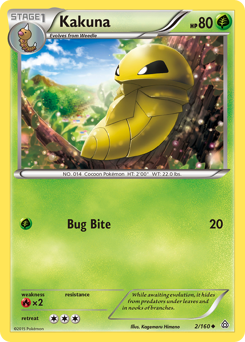
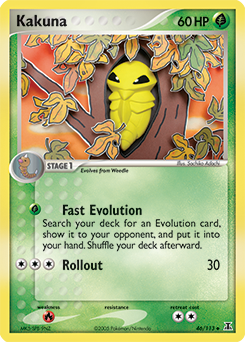
Kakuna (In-Game & PvE)
Verdict
 Kakuna is a deliberate roadblock you endure for three levels to get a
  Beedrill.
Rating 1/10 · Tier Untiered (Evolution Fodder) · Role : Early-game stepping stone
Strengths
- Evolves into Beedrill very early at level 10
- Takes minimal EXP to level up
- Can stall low-level physical attackers with Harden in desperate situations
Weaknesses
- Cannot deal meaningful damage
- Movepool is restricted to Harden if caught wild
- Abysmal defensive stats despite being a cocoon
- Completely unviable in any competitive or late-game scenario
Kakuna Base Stats

BEST COUNTERS


SIZE COMPARISON
SPRITE GALLERY
 OFFICIAL ARTWORK
 OFFICIAL SHINY
 HOME 3D
 HOME 3D SHINY
 FRONT
FRONT FRONT SHINY
 BACK
BACK BACK SHINY
 ANIMATED
 ANIMATED SHINY
Tier & Role: The Ultimate Evolution Fodder
Kakuna does not belong to any competitive tier. It is entirely unviable in serious PvP formats and holds no niche in modern metagames.
Its role is strictly educational within the context of a playthrough. Game Freak designed the early-route bug Pokémon to teach new players about the evolution mechanic.
You catch it, you level it up slightly, and you are rewarded with a fully evolved Pokémon very early in the game.
The EXP Sponge Role
Because Kakuna lacks the stats to fight independently, its primary function is to sit in your party and absorb experience points.
In older generations, this meant placing Kakuna at the front of your party and immediately switching it out for a stronger Pokémon—a tedious process known as switch-training.
With the universal EXP Share present in modern titles like Pokémon Scarlet/Violet, and expected to continue in Pokémon Legends: Z-A, this process is entirely automated.
You simply keep Kakuna in your party while your starter handles the battles, completely bypassing its combat limitations.
Best Uses & Matchups: Surviving the Early Routes
Kakuna does not win matchups. If you are forced to send Kakuna into battle, something has gone terribly wrong with your team composition.
However, during the very first routes of a playthrough, it can occasionally serve as a physical wall against low-level normal types.
If you are out of potions and need to stall a wild  Rattata or
  Pidgey, spamming Harden can keep Kakuna alive long enough to use a healing item on your main attacker.
The  Weedle Evolution Requirement
There is a massive difference between catching a wild Kakuna and evolving a Weedle.
- Wild Kakuna: Only knows Harden. It literally cannot deal damage unless it uses Struggle.
- Evolved Weedle: Retains Poison Sting and String Shot.
If you are playing a classic game without universal EXP Share, you must evolve a Weedle. Having Poison Sting allows Kakuna to slowly chip away at early-game grass types like  Oddish or
  Bellsprout.
String Shot provides minor utility by dropping the opponent's speed, allowing your next Pokémon to attack first if Kakuna faints.
Weaknesses: A Sitting Target
Kakuna is a Bug/Poison type, which is a notoriously poor defensive typing for the early game. It is weak to Flying, Fire, Psychic, and Rock.
Early routes are heavily populated by Flying-type birds (Pidgey,  Starly,
  Fletchling) that will easily exploit this weakness.
Despite its visual design as a hardened cocoon, its actual base defense stat is incredibly low. A super-effective Peck or Ember will often knock it out in one hit, even if you have managed to set up a Harden.
Zero Offensive Presence
Kakuna's biggest weakness is its complete inability to threaten the opponent. It has no setup moves, no status conditions (unless you kept Poison Sting), and no recovery.
In any battle against an opponent with a stat-boosting move, Kakuna becomes setup bait.
An enemy Pokémon can freely use Swords Dance, Dragon Dance, or Nasty Plot while Kakuna helplessly uses Harden, leading to your entire team getting swept once Kakuna inevitably faints.
Avoid If... & Better Alternatives
You should avoid using Kakuna if you are looking for a Pokémon that will contribute to boss fights, gym battles, or any form of competitive play.
It is a temporary burden you carry solely to obtain Beedrill. If you do not plan on using Beedrill on your final team, there is zero reason to catch or train a Kakuna.
Better Early-Game Alternatives
If you need an early-game Bug or Poison type that actually contributes to battles, consider these alternatives:
 Metapod: While similar to Kakuna, it evolves into
  Butterfree. Butterfree offers incredible early-game utility with Compound Eyes and Sleep Powder, making it vastly superior to Beedrill in most playthroughs.
- Nidoran (M/F): Available early in many games, the Nidoran lines offer excellent Poison-type offense, diverse movepools, and evolve into the powerhouse
 Nidoking and
  Nidoqueen.
  Zubat: Though frustrating to train initially, Zubat quickly gains useful moves like Bite and Wing Attack, eventually evolving into the exceptionally fast and useful
  Crobat.
For players focused on efficiency, skipping the early-game bugs entirely and relying on your starter until you find a stronger regional bird or elemental type is usually the optimal strategy.
Related Pokémon guides
Explore Evolution Lines
Frequently Asked Questions About Kakuna
Is Kakuna better than Metapod?
Metapod is generally preferred because it evolves into Butterfree, which offers excellent utility with Sleep Powder and Compound Eyes. Kakuna evolves into Beedrill, which is a fast physical attacker but falls off quickly in most playthroughs.
What is the best moveset for Kakuna?
Kakuna does not have a viable moveset. If evolved from Weedle, it will have Poison Sting, String Shot, and Harden. If caught wild, it only knows Harden. You just use whatever does chip damage until it evolves.
Can Kakuna be used in PvP?
Absolutely not. Kakuna has no offensive stats, no utility moves, and terrible defenses. Bringing it into any PvP format is essentially playing with a five-Pokémon team.
Why does my Kakuna only know Harden?
Wild Kakuna are caught with only Harden in their movepool. To get a Kakuna with attacking moves, you must catch a Weedle and evolve it at level 7, allowing it to retain Poison Sting and String Shot.
Pokedex.me is an unofficial fan site, not affiliated with Nintendo, Game Freak or The Pokémon Company. Competitive takes reflect observed usage (Smogon SV stats).