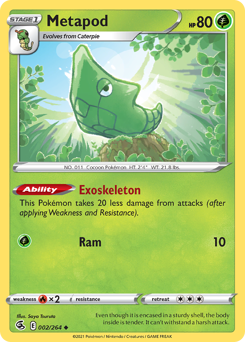
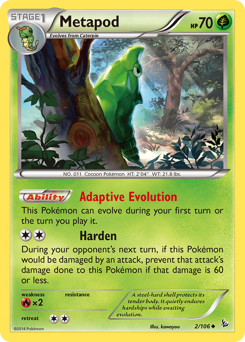
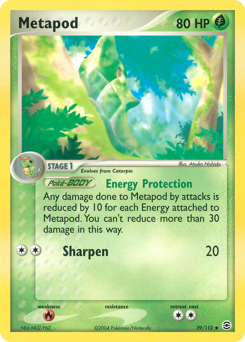
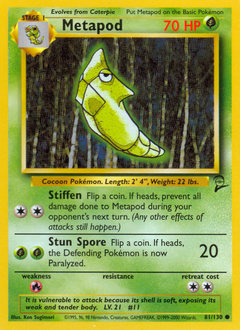
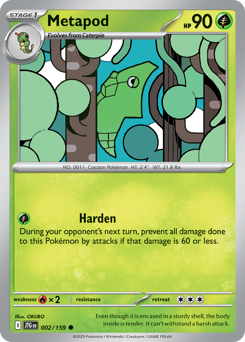
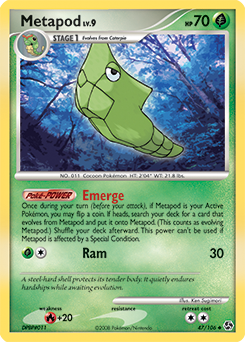
Metapod (In-Game & Competitive)
No,  Metapod is objectively terrible in both competitive PvP and general PvE playthroughs. Its abysmal base stat total of 205 and a movepool functionally restricted to Tackle, String Shot, and Harden make it useless in battle. Its sole purpose is surviving long enough to evolve into
  Butterfree.
Verdict
Metapod is a temporary roadblock meant to be evolved immediately, not a Pokémon you actually use in a fight.
Rating 1/10 · Tier Untiered (PvP) / F-(In-Game) · Role : Evolutionary Stepping Stone
Strengths
- Evolves into the highly useful Butterfree very early at level 10.
- Shed Skin ability can occasionally cure debilitating status conditions.
- Can theoretically hold an Eviolite to survive slightly longer while soaking up passive EXP.
Weaknesses
- Abysmal base 20 Attack and 30 Speed make it offensively useless.
- Movepool is practically non-existent, lacking any reliable damage or recovery.
- Base 55 Defense is entirely insufficient to function as a wall despite the Pokédex lore.
- Zero competitive viability in any format, including Little Cup.
Metapod Base Stats Breakdown

BEST COUNTERS
Effective Pokémon against metapod


SIZE COMPARISON
SPRITE GALLERY
 OFFICIAL ARTWORK
 OFFICIAL SHINY
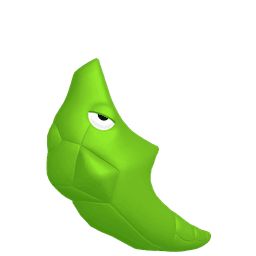 HOME 3D
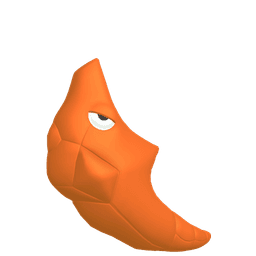 HOME 3D SHINY
 FRONT
FRONT FRONT SHINY
 BACK
BACK BACK SHINY
 ANIMATED
 ANIMATED SHINY
Tier & Role: A Statistical Dead End
Metapod sits firmly at the absolute bottom of any tier list, holding an Untiered status in Smogon formats and an F-tier ranking for main-series playthroughs. The core issue stems directly from its base stats. With a Base Stat Total (BST) of just 205, it cannot compete even against other unevolved early-route Pokémon.
Its base 20 Attack and 25 Special Attack mean it cannot deal meaningful damage, while its base 30 Speed guarantees it will take a hit before acting. Many new players ask if Metapod has hidden defensive potential because of its iconic anime appearances. The harsh reality is that it does not.
Stat Breakdown and Core Flaws
Unlike early-game birds like  Pidgey or rodents like
  Rattata, Metapod is not designed to fight. It is structurally built to be a punching bag. Its base 55 Defense is its highest stat, but without high HP (a meager base 50), it cannot absorb sustained damage from physical attackers.
Furthermore, its movepool is critically limited. A Metapod caught in the wild often only knows Harden. If evolved from  Caterpie, it retains Tackle, String Shot, and Bug Bite. This restricts its offensive output to weak, non-STAB Normal moves or a low-power Bug attack.
Its ability, Shed Skin, has a 33% chance to cure status conditions at the end of a turn. While useful in theory, Metapod rarely survives long enough against Poison or Burn damage for Shed Skin to trigger and actually matter.
The 'Harden' Strategy: Why Stalling Fails
Harden is Metapod's signature move, raising its Defense by one stage. Mechanically, this seems like it could create a physical wall. However, attempting a 'Harden stall' fundamentally fails in actual gameplay.
To successfully stall, a Pokémon needs reliable recovery moves like Roost or Recover, or passive damage like Toxic. Metapod has access to none of these. Boosting your Defense is useless if you cannot heal the chip damage you inevitably take turn after turn.
The Mechanics of its Failure
- No Recovery: Metapod cannot restore its HP outside of the player using items from the bag.
- Special Weakness: Harden only boosts physical Defense. Any Special Attack, especially Fire or Flying moves, will easily bypass its boosts and OHKO it.
- Zero Offensive Pressure: Opponents are free to set up their own stat boosts (like Swords Dance or Dragon Dance) because Metapod poses absolutely no threat.
There are extremely rare, theoretical instances in double battles where a Harden-boosted Metapod might absorb a physical hit. But even then, a smart opponent will simply ignore Metapod and target its partner, leaving the cocoon completely isolated.
In-Game Playthrough & Best Matchups
During a main series playthrough, from Kanto in Red/Blue to modern titles like Sword/Shield, Metapod serves one purpose. It exists to be evolved into Butterfree as quickly as possible. The optimal strategy is to keep it in the party merely to soak up passive experience.
In older generations without a universal EXP Share, players often had to employ the 'switch-training' method. You would send Metapod out first, then immediately switch to a stronger Pokémon to split the experience points. Modern mechanics in recent games completely bypass this tedious process, allowing Metapod to level up safely from the bench.
When Metapod Actually "Works"
If you are forced to battle with Metapod, its only winnable matchups are against significantly lower-level, purely physical attackers that lack setup moves. It can theoretically defeat:
- Low-level
 Magikarp that only know Splash or Tackle.
 - Unevolved early-route bugs like
 Weedle, assuming Metapod has Bug Bite.
 - Extremely weak Normal-types if Metapod has time to set up multiple Hardens and the opponent lacks critical hits.
Common player frustrations arise when attempting to use Metapod as a standard team member. It turns easy trainer battles into massive resource drains, forcing you to waste Potions constantly just to keep it alive.
Niche Competitive & Challenge Scenarios
In serious competitive formats, Metapod is entirely absent. It does not appear in Smogon SV stats, nor does it have any viability in VGC. Even in Little Cup (LC), a format specifically designed for unevolved Pokémon, Metapod is unplayable.
Little Cup is dominated by fast, hard-hitting unevolved Pokémon like  Mienfoo or
  Vullaby. Metapod's abysmal stats make it dead weight. However, it does see use in highly specific, self-imposed challenge runs.
Challenge Runs and Meme Formats
Content creators and hardcore fans occasionally attempt 'Metapod-only' playthroughs. These runs rely heavily on over-leveling, exploiting the AI's predictable move choices, and burning through hundreds of healing items. They prove that Metapod can beat a game, but only through immense attrition, not strategic viability.
In custom rulesets like 'Cocoon Cup', Metapod faces off against  Kakuna,
  Silcoon, and
  Cascoon. Even here, it struggles heavily if it doesn't have Bug Bite, often resulting in agonizingly slow Struggle wars.
Some players have ironically brought Metapod to VGC tournaments, equipping it with a Focus Sash. The goal is purely psychological or meme-driven, as it offers zero mechanical advantage to the team and essentially forces a 3v4 scenario.
Spin-offs, Anime & Comparisons
Metapod's cultural perception is heavily influenced by the Pokémon anime. Ash's Metapod famously engaged in a 'Harden vs. Harden' battle against a Samurai's Metapod. This iconic, comedic moment cemented its reputation as a useless, immobile cocoon within the broader fandom.
In spin-off titles like Pokémon Mystery Dungeon, Metapod plays slightly differently. String Shot has high utility in dungeons for slowing down enemies in narrow corridors. However, its stat growth remains incredibly poor compared to other recruits, making it a liability in late-game dungeons.
Metapod vs. Kakuna
When comparing Metapod to its counterpart Kakuna, they share the exact same transitional design philosophy. Both are meant to be temporary roadblocks for the player.
- Movepool: Kakuna can learn Poison Sting, giving it a slight offensive edge and a chance to poison opponents. Metapod relies on standard Normal or Bug damage.
- Typing: Kakuna's Bug/Poison typing gives it different resistances, though both are incredibly frail.
- Pokémon GO: In GO, Metapod requires 50 Caterpie candy to evolve. It has absolutely zero utility in GO Battle League or Raids, serving strictly as Pokédex filler.
Compared to newer early bugs like  Grubbin or
  Sewaddle, Metapod feels significantly worse. Modern bug designs often give the middle stage decent moves or unique typing, whereas Metapod remains a strict relic of Generation I design limitations.
Optimizing Metapod (If You Insist)
If you absolutely insist on using Metapod in battle, you must optimize its minimal capabilities. The most critical item is the Eviolite. This held item boosts the Defense and Special Defense of unevolved Pokémon by 50%.
With an Eviolite and maximum EV investment in HP and Defense, Metapod can survive a few physical hits. However, this is only a delay tactic. It still lacks the tools to retaliate or support the team effectively.
The Speed Control Suicide Lead
In formats like Sword and Shield, where Metapod has access to specific tutors, you can piece together a highly niche support set:
- Item: Focus Sash.
- Ability: Shed Skin.
- Moves: Electroweb, String Shot, Bug Bite, Harden.
- Role: Speed Control Lead.
Electroweb (taught via TR in Gen 8) and String Shot allow Metapod to lower the opponent's Speed. The strategy is to drop the enemy's Speed, survive exactly one hit thanks to the Focus Sash, and then faint. This allows a stronger teammate to enter the field safely with a Speed advantage.
Even with this heavy optimization, Metapod's performance is severely constrained. Any Prankster user or a faster Taunt lead completely shuts down this already fragile strategy, rendering it useless.
À éviter si… (Honest Weaknesses)
Metapod's weaknesses are comprehensive and inescapable. Its pure Bug typing makes it vulnerable to common offensive types like Fire, Flying, and Rock. Because its Special Defense is a meager base 25, any special attack will OHKO it, regardless of type effectiveness.
Its extreme reliance on held items like Eviolite or Focus Sash makes it instant bait for Knock Off. Once it loses its item, its fragile base stats are fully exposed, and it crumbles immediately.
When to Avoid Metapod Completely
You should never bring Metapod into any serious battle scenario. Specifically, keep it out of your party if:
- You are playing PvP Ranked: Metapod is a wasted team slot. If you need a bulky redirector or support, use a real Pokémon like
 Amoonguss or
  Clefairy.
 - You are facing a Gym Leader: Even in the early game, Gym Leaders will sweep Metapod effortlessly.
- You need a defensive wall: Do not let the Pokédex entries fool you. Its shell is not a viable defense. If you need an early-game physical wall, capture a
 Geodude or an
  Aron instead.
Ultimately, Metapod is an evolutionary stepping stone. The moment it reaches level 10, evolve it into Butterfree. Keeping it as a Metapod offers zero strategic benefits and actively hinders your team's success.
Related Pokémon guides
Explore Evolutionary Lines
Frequently Asked Questions About Metapod
Is Metapod better than Kakuna?
No, they are equally terrible in battle. While Kakuna gets Poison Sting for a slight chance to inflict status, Metapod relies on Tackle or Bug Bite. Both exist solely to be evolved at level 10 and offer zero competitive value.
Can Metapod be good in Little Cup?
Absolutely not. Little Cup is highly competitive, featuring hard-hitting unevolved Pokémon like Mienfoo and Vullaby. Metapod's base 205 stat total and lack of offensive pressure make it complete dead weight in the format.
What is the best moveset for Metapod?
The best you can do is a Speed-control suicide lead in Gen 8 (Sword/Shield) using String Shot, Electroweb, Bug Bite, and Harden, holding a Focus Sash. Its only goal is to lower the opponent's Speed before fainting.
Why do people use Metapod in playthroughs?
Players only keep Metapod in their party to evolve it into Butterfree. Butterfree is a fantastic early-game Pokémon with access to Sleep Powder and Compound Eyes. Keeping Metapod unevolved is only done for self-imposed meme challenge runs.
Pokedex.me is an unofficial fan site, not affiliated with Nintendo, Game Freak or The Pokémon Company. Competitive takes reflect observed usage (Smogon SV stats).