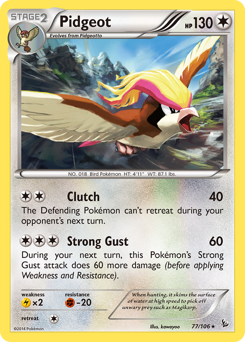
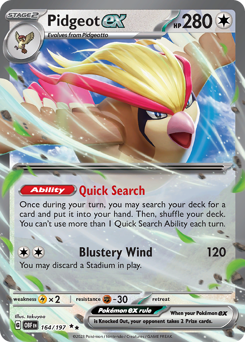
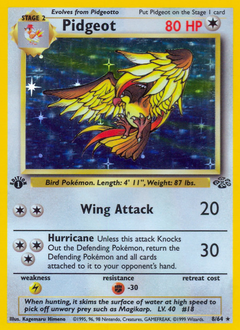
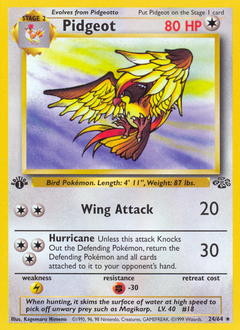
Pidgeot (In-Game & Casual Play)
 Pidgeot is strictly an in-game Pokémon that falls flat in any serious competitive format. While its high Speed and access to Roost make it a reliable early-game flyer for story playthroughs, its mediocre Attack and predictable movepool prevent it from breaking through sturdy opponents later on.
Verdict
Pidgeot is a fast but fundamentally weak Flying-type that relies heavily on nostalgia rather than actual combat prowess.
Rating 4/10 · Tier C-(In-Game Playthroughs) · Role : Fast Physical Pivot / Story Sweeper
Strengths
- Excellent base Speed easily outpaces most in-game NPC opponents.
- Access to reliable recovery with Roost.
- Gets U-turn for easy pivoting during story battles.
Weaknesses
- Terrible offensive stats make it struggle to secure KOs against bulky targets.
- Extremely shallow physical movepool with zero coverage against Rock or Steel.
- Completely outclassed mechanically by almost every other regional bird.
Pidgeot Base Stats

BEST COUNTERS


SIZE COMPARISON
SPRITE GALLERY
 OFFICIAL ARTWORK
 OFFICIAL SHINY
 HOME 3D
 HOME 3D SHINY
 FRONT
FRONT FRONT SHINY
 BACK
BACK BACK SHINY
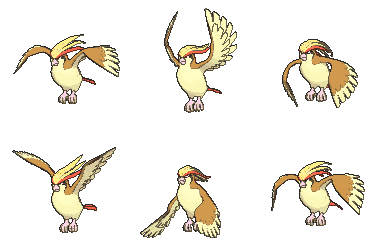 ANIMATED
 ANIMATED SHINY
Tier & Role: A Story-Mode Sprinter
Pidgeot sits firmly in the lower tiers of casual play, acting primarily as a fast physical pivot for main story playthroughs. Its defining trait is its high Speed, which allows it to naturally outpace the majority of NPC trainers you encounter.
However, speed alone does not win battles. Pidgeot suffers from a glaring lack of offensive pressure. Its Attack stat is remarkably average, meaning it often fails to secure one-hit knockouts even against neutral targets.
In a typical playthrough, you will use it as a hit-and-run attacker. Thanks to its access to U-turn, Pidgeot can scout enemy leads, deal chip damage, and safely bring in a heavier hitter.
Without its Mega Evolution—which is currently absent from modern generations—Pidgeot lacks the Special Attack and No Guard ability to function as a special wallbreaker. You are strictly locked into a physical moveset that feels outdated compared to modern power creep.
Best Uses & Favorable Matchups
Pidgeot shines brightest during the early-to-mid stages of a Pokémon journey. When enemy teams are unevolved and lack bulky defensive stats, its speed and STAB (Same Type Attack Bonus) Flying moves are sufficient to sweep.
It naturally dominates specific archetypes commonly found on NPC teams:
- Grass-type specialists: Pidgeot outspeeds and easily OHKOs standard Grass types with Wing Attack, Aerial Ace, or Fly.
- Bug Catchers and early trainers: Its typing resists Bug-type moves, making it a safe switch-in during forest routes.
- Ghost-type encounters: The Normal typing grants a crucial immunity to Ghost moves, giving it a free switch against spammy AI opponents.
Additionally, Pidgeot serves as a reliable utility Pokémon. Access to Roost means you spend fewer Potions between routes, making dungeon crawling significantly less tedious.
Optimal Moveset for Story Playthroughs
Because Pidgeot’s physical movepool is notoriously shallow, building a moveset is straightforward but rigid. You have very few coverage options to handle its natural counters.
A standard and effective in-game moveset looks like this:
- Brave Bird or Fly: Your primary Flying STAB. Fly is essential for map navigation in older games, while Brave Bird offers raw power if you don't mind recoil.
- Return or Double-Edge: A max-happiness Return hits surprisingly hard and provides consistent Normal-type STAB without drawbacks.
- U-turn: The best utility move in its arsenal, allowing Pidgeot to escape unfavorable matchups while dealing chip damage.
- Roost: Essential for healing off Brave Bird recoil or general damage sustained during long routes.
For held items, a Sharp Beak or Silk Scarf maximizes its damage output. If you are using Double-Edge or Brave Bird, a Shell Bell or Leftovers can help mitigate the recoil damage over time.
Abilities and Item Synergy
Pidgeot’s abilities are another reason it struggles to find a solid foothold even in casual play. You are usually stuck choosing between Keen Eye and Tangled Feet.
Keen Eye ignores evasion boosts and prevents accuracy drops. While occasionally useful against annoying early-game Sand-Attack spammers, it provides zero offensive or defensive pressure. Tangled Feet boosts evasion when confused, which is far too unreliable to build a strategy around.
Because its abilities offer no damage multipliers, you must rely entirely on held items to fix its mediocre damage output.
- Choice Band: The only way to make Pidgeot hit genuinely hard. It locks you into one move but allows Brave Bird to actually threaten neutral targets.
- Heavy-Duty Boots: If you are playing a format with entry hazards, this is mandatory to prevent Pidgeot from losing a quarter of its health every time it switches in.
- Sharp Beak: A simple, penalty-free boost to its Flying-type attacks, perfect for a standard story playthrough.
Core Weaknesses and Limitations
The biggest issue with Pidgeot is its inability to scale into the late game. As gym leaders and Elite Four members start fielding fully evolved, bulky Pokémon, Pidgeot’s damage output falls off a cliff.
It is completely walled by common defensive typings:
- Rock and Steel types: Pidgeot has absolutely no physical coverage to break through them. You are forced to U-turn out immediately or risk getting knocked out.
- Electric types: Faster Electric types will effortlessly outspeed and OHKO Pidgeot before it can even act.
Even against neutral targets, Pidgeot's base Attack simply isn't high enough to break through dedicated physical walls like  Slowbro or
  Hippowdon. It becomes dead weight in prolonged battles.
When to Avoid Pidgeot & Better Alternatives
You should absolutely avoid keeping Pidgeot on your team if you are aiming for post-game battle facilities, competitive PvP, or if your team already lacks raw physical power. It is a momentum sink against bulky teams.
If you need a Flying-type that actually pulls its weight, the franchise offers vastly superior alternatives:
 Staraptor: The gold standard for regional birds. It possesses Intimidate, a monstrous Attack stat, and access to Close Combat to obliterate the Steel and Rock types that wall Pidgeot.
 Talonflame: Offers a much better secondary typing (Fire) and priority Flying moves via Gale Wings, making it infinitely more useful for speed control.
 Corviknight: If you want a bulky bird, Corviknight provides incredible defensive utility, a phenomenal Steel/Flying typing, and reliable setup with Bulk Up.
Ultimately, Pidgeot is a nostalgia pick. If you aren't attached to its classic Generation 1 design, there is almost no mechanical reason to choose it over its successors.
Related Pokémon guides
Explore Pokedex.me
Frequently Asked Questions about Pidgeot
Is Pidgeot good in competitive Pokémon?
No. Pidgeot is not viable in standard competitive formats. Its offensive stats are too low to threaten the meta, and without its Mega Evolution, it lacks the firepower and ability to compete with modern wallbreakers.
What is the best nature for Pidgeot?
Jolly is the absolute best nature for Pidgeot. Since its Attack is already mediocre, maximizing its Speed ensures it can outpace threats and safely use U-turn to pivot out of danger.
Does Pidgeot learn any good coverage moves?
Unfortunately, no. Pidgeot suffers from a very shallow physical movepool. Aside from Normal and Flying STAB moves, U-turn, and Steel Wing, it has almost no way to hit Rock or Steel types effectively.
Is Mega Pidgeot ever coming back?
Mega Evolution has been absent from recent mainline games. Until Game Freak officially reintroduces the mechanic in future titles, Mega Pidgeot remains completely inaccessible in modern formats.
Pokedex.me is an unofficial fan site, not affiliated with Nintendo, Game Freak or The Pokémon Company. Competitive takes reflect observed usage (Smogon SV stats).