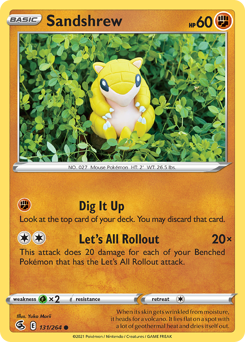
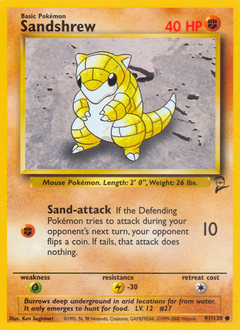
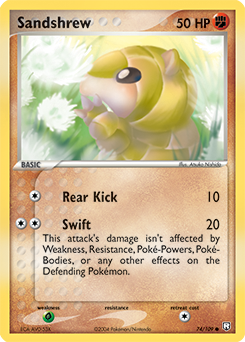
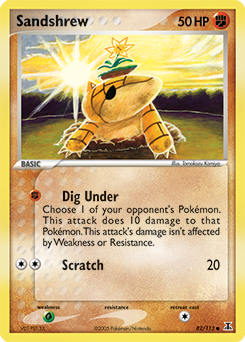
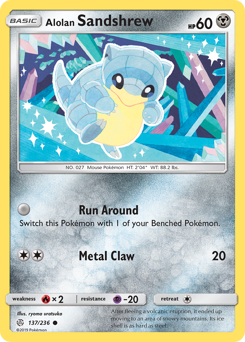
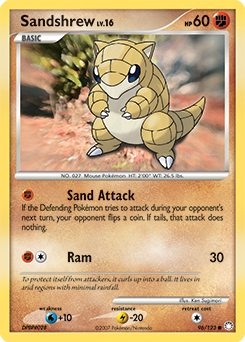
Sandshrew (Competitive & In-Game)
 Sandshrew is highly situational. In standard playthroughs, its Kanto form is a reliable early-game physical tank. In competitive Scarlet and Violet Little Cup (LC), it holds a niche 0.7% usage rate as a Rapid Spin utility lead or Sand Rush sweeper, but struggles heavily against special attackers.
Verdict
Sandshrew is a weather-dependent physical specialist that shines in Little Cup sand teams but falls flat against special attackers.
Rating 5/10 · Tier LC · Role : Physical Sweeper / Utility Spinner
Strengths
- Access to Rapid Spin, Stealth Rock, and Spikes makes it a versatile entry hazard manager.
- Sand Rush ability doubles its Speed in a Sandstorm, turning it into a potent physical sweeper.
- Excellent base Defense allows it to shrug off unboosted physical hits when holding an Eviolite.
Weaknesses
- Abysmal Special Defense makes it instant setup fodder for Water and Grass-type special attackers.
- Extremely reliant on Sandstorm support to fix its terrible base Speed.
- Faces fierce competition from other Ground-types with better secondary typings or abilities.
Sandshrew Base Stats & Viability

BEST COUNTERS


SIZE COMPARISON
SPRITE GALLERY
 OFFICIAL ARTWORK
 OFFICIAL SHINY
 HOME 3D
 HOME 3D SHINY
 FRONT
FRONT FRONT SHINY
 BACK
BACK BACK SHINY
 ANIMATED
 ANIMATED SHINY
The Dual Nature of Sandshrew's Goodness
Evaluating Sandshrew requires splitting the verdict between its original Ground-type Kanto form and its Ice/Steel-type Alolan variant. Both forms have distinct roles across main series games and competitive formats, including the current Pokémon Scarlet and Violet meta and the upcoming Legends: Z-A.
Kanto Sandshrew is a pure Ground-type built entirely around physical Defense and Attack. It operates as a slow, methodical physical wall that chips away at opponents. Alolan Sandshrew flips this script entirely, trading a single weakness profile for a highly volatile Ice/Steel typing that offers incredible offensive STAB (Same Type Attack Bonus) but disastrous defensive vulnerabilities.
In both cases, Sandshrew is a Pokémon of extremes. It excels in very specific physical matchups but crumbles instantly when forced out of its comfort zone. Your success with it depends entirely on keeping it away from special attackers and leveraging its weather-based abilities.
Kanto Sandshrew: In-Game Journey & Utility
For an in-game playthrough, particularly in Generation 1 (RBY) or Generation 3 remakes (FRLG), Kanto Sandshrew is a highly accessible early-game asset. You can catch it early on Route 4 or Route 11, giving you an immediate answer to Lt. Surge's Electric-type gym.
Its high physical Defense makes it a reliable sponge against common early-game Normal and Flying-type attacks. Once it learns Dig or is taught the Earthquake TM, it hits surprisingly hard. It completely walls physical attackers that lack coverage moves, making it a safe switch-in during standard trainer battles.
However, the mid-game exposes its fatal flaws. Misty's  Starmie or Erika's
  Vileplume will instantly knock it out due to its pathetic Special Defense. If you are playing a standard storyline, Sandshrew is a solid bridge to the mid-game, but you will likely bench it or evolve it into
  Sandslash before facing the Elite Four.
Alolan Sandshrew: Utility in Sun & Moon
Alolan Sandshrew's unique Ice/Steel typing completely changes its in-game viability in Pokémon Sun, Moon, and their Ultra variants. Unfortunately, its late-game accessibility on Mount Lanakila means you miss out on using it for the majority of the island challenge.
When you finally get it, it shines against specific late-game threats, particularly Dragon and Flying types. Its access to Iron Head and Icicle Crash provides excellent neutral coverage. If you are running a Hail team, its Slush Rush ability makes it a surprisingly fast sweeper.
The trade-off is severe. Alolan Sandshrew carries two crippling 4x weaknesses to Fighting and Fire, along with a 2x weakness to Ground. In a playthrough, an unexpected Mach Punch or Flamethrower from a random trainer will send it straight back to the Pokémon Center. It requires careful pivoting and cannot be left in against unknown movesets.
Competitive Niche: Little Cup & Abilities
In the current Pokémon Scarlet and Violet Little Cup (LC) meta, Kanto Sandshrew holds a marginal 0.7% usage rate. It is not a splashable Pokémon; it demands a team built around its specific traits. Its primary role is either a Sand Rush physical sweeper or a dedicated hazard setter and remover.
The Sand Rush Sweeper Set
To make Sandshrew an offensive threat, you must pair it with a Sandstorm setter. Under sand, Sand Rush doubles its Speed, allowing it to outpace the unboosted LC metagame.
- Item: Eviolite or Choice Band
- Ability: Sand Rush
- Moves: Earthquake, Knock Off, Rapid Spin, Swords Dance
Earthquake is the mandatory STAB, while Knock Off cripples Eviolite-reliant walls. Rapid Spin provides utility and a Speed boost, and Swords Dance turns it into a wallbreaker if you predict a switch.
The Utility Lead Set
If you opt for its Sand Veil ability, Sandshrew functions as a suicide lead or utility pivot, relying on evasion in sand to survive an extra turn.
- Item: Focus Sash or Leftovers
- Ability: Sand Veil
- Moves: Stealth Rock, Spikes, Earthquake, Smack Down
This set focuses on stacking hazards. Smack Down is crucial here, as it grounds Flying-types and Levitators, forcing them to take Spikes damage and making them vulnerable to Earthquake.
Best Teammates & Synergies
Sandshrew cannot function alone in competitive play. It requires teammates that cover its glaring weaknesses to Water, Grass, and Ice attacks.
 Shellos: An essential partner. Shellos easily absorbs the Water-type attacks aimed at Sandshrew and provides a solid defensive pivot.
 Fuecoco: Excellent for taking Grass and Bug-type hits. Fuecoco's bulk and typing perfectly complement Sandshrew's physical Ground-type presence.
 Chespin: Provides a Grass resistance and can form a physical defensive core, helping to wear down shared checks.
 Stunky &
  Wattrel: Stunky handles Ghost-types that block Rapid Spin, while Wattrel provides an immunity to Ground and resists Grass, forming a classic Ground/Flying pivot core.
Without these specific defensive partners, Sandshrew will be easily overwhelmed by the special attackers that dominate the LC tier.
Evolutionary Line: Sandslash's Impact
A common question is whether evolving Sandshrew into Sandslash fixes its problems. The short answer is no, but it shifts its viability to higher tiers like PU or RU. Sandslash gains a significant boost to Attack and Defense, making it a much more reliable physical tank.
However, Sandslash inherits the exact same flaws: terrible Special Defense and low Speed. In modern competitive formats, Sandslash is entirely outclassed by other Ground-types like  Donphan or
  Excadrill, who offer better stats, secondary typings, or utility.
For an in-game playthrough, you should evolve Sandshrew at level 22 immediately. There is no benefit to delaying the evolution, as Sandslash learns the same crucial moves (like Earthquake via TM) and desperately needs the stat boost to survive mid-game routes.
Spin-offs: Pokémon GO & Mystery Dungeon
In Pokémon GO, Kanto Sandshrew is essentially useless in both PvE raids and PvP. Its stats do not translate well to the CP formula. However, Alolan Sandshrew has seen niche play in specific restricted formats like the Little Jungle Cup, where its Ice/Steel typing walls certain Flying and Dragon threats.
If you play Pokémon Mystery Dungeon: Rescue Team DX, Sandshrew is a surprisingly robust partner. Ground-type moves like Earthquake hit the entire room, making it an excellent choice for clearing Monster Houses. Its high Defense also helps it survive the grueling physical hits in longer dungeons.
Despite these niche uses, Sandshrew remains a secondary choice in almost all spin-off titles, often overshadowed by more popular or statistically superior Ground-types.
Weaknesses & When NOT to play it
Sandshrew's biggest flaw is its base 30 Special Defense. Any special attack, even a neutral one, will severely damage or OHKO it. You should never leave Sandshrew in against Water, Grass, or Ice-type special attackers.
Furthermore, without Sandstorm support, its base 40 Speed means it will almost always take a hit before it can attack. If you are not running a dedicated weather team, Sandshrew becomes dead weight in competitive play.
Avoid using Sandshrew if:
- You need a fast, standalone attacker.
- Your team is already weak to Water or Grass types.
- You are playing in a format where
 Drilbur is legal.
The Alternative: If you need a Ground-type Rapid Spinner in Little Cup, Drilbur is objectively better. Drilbur has higher Attack, better Speed, and access to Mold Breaker, allowing it to hit Levitators with Earthquake without needing Smack Down.
Related Pokémon guides
Competitive Guides
Frequently Asked Questions About Sandshrew
Is Alolan Sandshrew better than Kanto Sandshrew?
Yes, in specific weather teams. Alolan Sandshrew's Ice/Steel typing and Slush Rush ability make it a dangerous sweeper in Hail/Snow. However, its 4x weaknesses to Fighting and Fire make it much harder to keep alive than the pure Ground-type Kanto form.
What is the best moveset for Sandshrew in Scarlet and Violet?
For competitive Little Cup, the optimal set is Earthquake, Rapid Spin, Knock Off, and Stealth Rock (or Swords Dance). You must equip it with an Eviolite to survive physical hits and run the Sand Rush ability alongside a Sandstorm setter.
Should I evolve Sandshrew immediately?
Yes. Evolve it into Sandslash at level 22. There is no advantage to delaying the evolution in modern games, as Sandslash gains a massive boost to its Attack and Defense stats, which are mandatory to survive mid-game battles.
Is Sandshrew good in Pokémon GO PvP?
Kanto Sandshrew is terrible in Pokémon GO PvP. Alolan Sandshrew has a tiny niche in 500 CP restricted cups (like Little Cup), but you are almost always better off evolving it into Alolan Sandslash for use in the Great League.
Pokedex.me is an unofficial fan site, not affiliated with Nintendo, Game Freak or The Pokémon Company. Competitive takes reflect observed usage (Smogon SV stats).