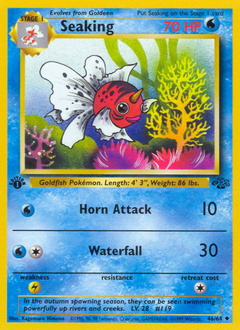
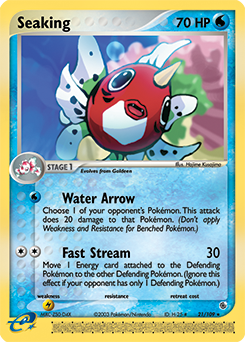
Seaking (In-Game & Competitive)
No,  Seaking is generally a bad Pokémon in both competitive play and modern playthroughs. For in-game story modes, it functions as a passable physical Water-type, but its low base Speed of 68 and mediocre defenses make it a liability. In serious PvP, severe power creep renders it entirely unviable.
Verdict
Seaking is outclassed by almost every other Water-type available, requiring too much setup for too little payoff.
Rating 3/10 · Tier Untiered (PvP) / C-(In-Game) · Role : Niche Physical Attacker / Electric-Immunity Pivot
Strengths
- Lightning Rod ability provides a rare and valuable Electric immunity for a Water-type.
- Access to Megahorn and Drill Run offers surprising physical coverage against Grass and Electric threats.
- Decent base 92 Attack allows for respectable Waterfall damage in casual playthroughs.
Weaknesses
- Abysmal base 68 Speed leaves it outpaced by most offensive threats.
- Mediocre 80/65/80 bulk means it cannot survive neutral hits from modern wallbreakers.
- Lacks reliable physical setup moves like Dragon Dance or Swords Dance.
- Completely outclassed by modern physical Water-types like
 Palafin,
  Basculegion, and
  Gyarados.
Seaking Base Stats

BEST COUNTERS
Effective Pokémon against seaking


SIZE COMPARISON
SPRITE GALLERY
 OFFICIAL ARTWORK
 OFFICIAL SHINY
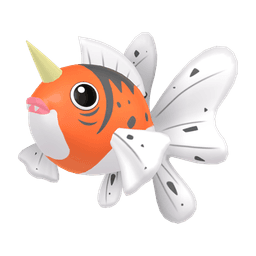 HOME 3D
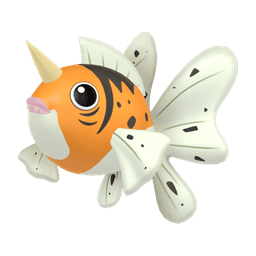 HOME 3D SHINY
 FRONT
FRONT FRONT SHINY
 BACK
BACK BACK SHINY
 ANIMATED
 ANIMATED SHINY
Tier & Role: Stats, Abilities, and Movepool Analysis
Seaking currently sits at the very bottom of the competitive barrel, lacking any official tier placement in modern Smogon SV formats. You should consider it entirely unviable for serious ranked play. Its stat distribution is fundamentally flawed for a modern attacker.
With a passable base 92 Attack and 80 HP, it can theoretically trade hits in lower-level environments. However, its abysmal base 68 Speed guarantees it takes damage before moving against most threats. Its defensive profile of 65 Defense and 80 Special Defense simply cannot absorb the heavy hits prevalent in today's metagame.
Abilities That Define Its Niche
If you are forced to use Seaking, its abilities are its only saving grace. Lightning Rod completely flips its Electric-type weakness, turning it into an immunity. This provides a highly specific pivot opportunity in double battles or predicted switches.
Swift Swim doubles its Speed under rain, theoretically fixing its biggest flaw. While Water Veil prevents burns that would otherwise cripple its physical damage output, it remains a strictly inferior choice compared to the utility of Lightning Rod or Swift Swim.
Movepool Limitations
The physical movepool offers a few bright spots. It relies on Waterfall for consistent STAB damage. The real surprise comes from its coverage options.
- Megahorn: Punishes Grass-types attempting to switch in.
- Drill Run: Catches Electric-types off guard, especially if Lightning Rod is active.
- Knock Off: Provides utility by removing opponent items.
Despite these options, Seaking suffers from a fatal lack of setup. Without access to Dragon Dance or Swords Dance, it cannot boost its mediocre Attack stat to threatening levels.
In-Game Performance: Story Modes & Playthroughs
For casual story playthroughs, Seaking is a textbook example of a placeholder Pokémon. Catching a  Goldeen in early routes often feels like a chore due to its fragile nature. Before evolving at level 33, Goldeen relies on weak moves like Peck and Horn Attack, making it a liability against early Gym Leaders.
Once it evolves, Seaking historically served as a dedicated HM user. Its ability to learn Surf, Waterfall, and Dive made it a convenient utility piece for navigating water routes in older generations. However, modern games have largely phased out HMs, stripping away this utilitarian role.
Comparing the Alternatives
If you need a Water-type for your story team, you have drastically better options.  Magikarp evolves much earlier at level 20 into the vastly superior Gyarados, which offers Intimidate and immediate Dragon Dance sweeping potential.
 Eevee is readily available in most titles and evolves into
  Vaporeon, providing massive bulk and reliable recovery. Even common encounters like
  Floatzel or
  Barraskewda offer the immediate Speed that Seaking desperately lacks.
- Gyarados: Better stats, better abilities, better setup.
- Vaporeon: Superior bulk and special attacking prowess.
- Palafin (Gen 9): Completely outclasses Seaking in every physical metric.
Using Seaking in a playthrough is ultimately a self-imposed challenge. It will struggle heavily in late-game battles, particularly against Elite Four members who utilize fast, synergistic teams.
Competitive Sets: The Rain Sweeper Illusion
Historically, Seaking found itself relegated to the depths of PU and NU tiers in older Smogon formats. Its primary competitive role has always been a niche Swift Swim abuser on dedicated rain teams. Even in these lower tiers, it faced stiff competition from faster or stronger alternatives.
The Choice Band Rain Set
If you attempt to bring Seaking into a competitive format, a Choice Band set under rain is the only mathematically justifiable approach. This maximizes its immediate damage output, compensating for its lack of setup moves.
- Item: Choice Band or Life Orb.
- Ability: Swift Swim.
- EVs: 252 Attack / 4 Special Defense / 252 Speed.
- Moveset: Waterfall, Megahorn, Drill Run, Knock Off.
Under rain, a Choice Band Waterfall hits reasonably hard. Megahorn remains crucial for threatening Grass-type switch-ins like  Tangela or
  Gourgeist in lower tiers. However, locking into an attack with Choice Band makes Seaking incredibly predictable.
VGC and Double Battle Struggles
In VGC or double battles, Seaking's viability drops even further. While Lightning Rod can theoretically protect a flying or water-type partner from Electric attacks, Seaking itself exerts zero offensive pressure. Opponents can simply ignore it and focus down its partner.
Other Swift Swim users like  Ludicolo,
  Kingdra, or Barraskewda offer vastly superior typing, speed, or damage output. Seaking simply does not possess the stat total to justify a team slot in any serious doubles format.
Best Matchups & Team Synergies
Despite its glaring flaws, Seaking can occasionally force favorable matchups if positioned perfectly. Its success relies entirely on exploiting its unique coverage moves and ability interactions. You must play predictively to extract any value from it.
Winning the Electric Matchup
The most satisfying use of Seaking involves hard-switching it into a predicted Electric-type attack. With Lightning Rod equipped, it absorbs the hit, takes zero damage, and gains a Special Attack boost.
While the Special Attack boost is useless for its physical sets, the free turn allows Seaking to retaliate with Drill Run. This specific interaction can severely punish fragile Electric-types like  Jolteon or
  Regieleki who blindly click Thunderbolt.
Rain Synergies
Seaking cannot function independently; it requires dedicated team support.  Pelipper and
  Politoed are mandatory partners for activating Drizzle. Without their automatic weather setting, Seaking is too slow to accomplish anything.
- Pelipper: Sets rain, provides a slow U-turn to bring Seaking in safely.
- Politoed: Offers alternative rain support with Encore utility.
 Ferrothorn: A great defensive partner that resists the Grass and Electric moves aimed at Seaking.
When the rain is active, Seaking can effectively pressure Ground, Rock, and Fire-types. A rain-boosted Waterfall will comfortably 2HKO most neutral targets that lack heavy physical bulk.
Honest Weaknesses: When NOT to Draft Seaking
Honesty is crucial when evaluating Seaking: it is a bad Pokémon with easily exploitable weaknesses. Its base 68 Speed is its death knell. Outside of rain, almost every offensive threat in the game will attack it first, and its 65 Defense cannot withstand strong physical hits.
Types That Punish Seaking
Bulky Grass-types are Seaking's worst nightmare. Pokémon like Ferrothorn,  Amoonguss, and
  Rillaboom can comfortably absorb a Megahorn and retaliate with super-effective STAB moves. Rillaboom's Grassy Glide is particularly devastating, ignoring Swift Swim's speed boost entirely due to priority.
Fast Electric-types that do not fear Drill Run, such as Rotom-Wash, completely wall Seaking. Rotom-Wash resists Waterfall, takes neutral damage from Megahorn, and is immune to Drill Run thanks to Levitate.
When to Avoid Drafting It
You should actively avoid putting Seaking on your team in almost every scenario. Do not draft it if you are playing a format without automatic weather setters. Do not use it if your team already struggles against Grass-types.
- Avoid in Ranked PvP: It lacks the stats to compete with modern threats.
- Avoid in late-game playthroughs: It will slow down your progression against Elite Four teams.
- Alternative: Use Basculegion for a physical Water-type ghost with Adaptability, or Barraskewda for a vastly superior Swift Swim physical sweeper.
Relying on Seaking requires building your entire strategy around masking its deficiencies, which is a highly inefficient way to play.
Seaking in Scarlet/Violet & Legends: Z-A Context
The competitive landscape of Pokémon has drastically shifted in recent years, leaving Seaking further behind. In Generation 8's Sword and Shield, Dynamax provided a brief glimmer of hope. Max Geyser allowed it to set its own rain, while Max Strike offered speed control.
However, the transition to Scarlet and Violet in Generation 9 exposed its fundamental stat weaknesses. The introduction of Terastallization offers some defensive utility, but it is rarely enough to save it.
Terastallization in Scarlet & Violet
If you bring Seaking into Paldea, Terastallization is mandatory for survival. Tera Grass is the most common defensive choice, flipping its weaknesses to Grass and Electric into resistances. Tera Poison is another valid option, boosting Poison Jab while resisting Grass-type assaults.
- Tera Water: Maximizes damage output on Choice Band Waterfall under rain.
- Tera Grass: Defensive pivot to survive Rillaboom or Amoonguss.
- Tera Ground: Boosts Drill Run to secure OHKOs on bulky Electric-types.
Anticipating Legends: Z-A
Looking ahead to Pokémon Legends: Z-A in 2025/2026, Seaking's viability is unlikely to improve. If the game follows the mechanics of Legends:  Arceus, abilities like Swift Swim or Lightning Rod might be removed entirely, stripping Seaking of its only defining traits.
Furthermore, the relentless power creep introduced by Paradox Pokémon like  Iron Bundle or
  Flutter Mane means Seaking simply does not have the stat total to survive in modern environments. It remains a relic of an older, slower era of Pokémon.
Lore, Design, and Common Trainer Pitfalls
Beyond the battlefield, Seaking maintains a modest cultural footprint. Its visual design is heavily inspired by koi and goldfish, featuring an elegant, flowing tail and a prominent golden horn. It embodies a king of the water aesthetic that resonates with fans of classical, animal-inspired Pokémon designs.
Its Pokédex entries frequently highlight its highly territorial nature and the intense spawning rituals it undertakes during the autumn months. These lore details give it a distinct personality, even if its battle performance falls flat.
Common Trainer Mistakes
The most frequent pitfall casual players make is attempting to use Seaking as a mixed or special attacker. Because it learns moves like Surf, Ice Beam, and Hydro Pump, beginners often equip it with special attacks. With a base 65 Special Attack, this completely neuters its damage potential.
Another common mistake is running Swift Swim without a dedicated rain setter. Relying on manual Rain Dance wastes a crucial turn and leaves Seaking vulnerable to immediate knockouts.
The Final Verdict
Ultimately, Seaking is an objective downgrade compared to almost every other Water-type in the franchise. While its access to Lightning Rod and Megahorn provides a unique flavor, these traits are not enough to salvage its poor stat distribution.
It is perfectly adequate for a nostalgic, casual playthrough where optimization does not matter. However, for any player looking to build an efficient, powerful team, Seaking should be left in the PC box.
Related Pokémon guides
Explore Competitive Builds
Frequently Asked Questions About Seaking
Is Seaking better than Gyarados?
No. Gyarados is vastly superior to Seaking in every measurable way. Gyarados possesses much higher base stats, the incredible Intimidate ability, and access to Dragon Dance, making it a premier physical sweeper in both playthroughs and competitive formats.
What is the best moveset for Seaking?
The most optimal moveset utilizes a Choice Band with the Swift Swim ability under rain. The required moves are Waterfall for STAB, Megahorn for Grass-types, Drill Run for Electric-types, and Knock Off for utility and item removal.
Does Seaking have any competitive use?
Its only competitive niche revolves around its Lightning Rod ability in double battles. By drawing in Electric-type attacks, it can protect vulnerable teammates like Gyarados or Pelipper, though it exerts almost zero offensive pressure itself.
Can you use Seaking in Pokémon Scarlet and Violet?
Yes, Seaking is available in Scarlet and Violet via The Teal Mask DLC. However, it struggles heavily against the modern power creep of Paldea and requires Terastallization (typically Tera Grass or Tera Water) just to survive basic encounters.
Pokedex.me is an unofficial fan site, not affiliated with Nintendo, Game Freak or The Pokémon Company. Competitive takes reflect observed usage (Smogon SV stats).