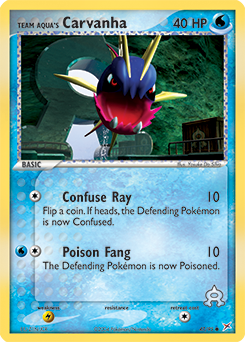
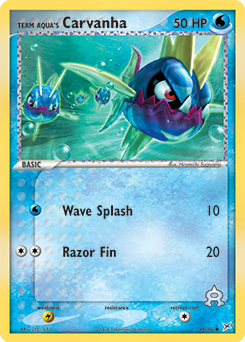
The Evolution Mechanic and Leveling Path
 Carvanha evolves into
  Sharpedo exactly at level 30. No evolution stones, trading, or friendship mechanics are required. As an unofficial fan-site, Pokedex.me focuses on these competitive realities and mechanical facts to optimize your playthrough.
Because Carvanha sits in the Slow experience group, reaching level 30 takes 33,750 EXP points. Players grinding in standard playthroughs should utilize the Exp. Share or Lucky Egg to bypass its extreme frailty during the mid-game. Wild Carvanha caught with a Super Rod often spawn between levels 25 and 35, meaning you can trigger evolution with a single Rare Candy.
Holding off evolution is rarely beneficial. Carvanha learns Take Down at level 28 and Agility at level 32, but Sharpedo learns these at identical or slightly delayed intervals (Agility at level 34). Evolving immediately at level 30 grants a massive jump in base stats, particularly pushing Attack from 90 to 120, which is necessary for physical damage output.
Competitive Role and Pokedex.me Verdict
Sharpedo functions strictly as a late-game cleaner or glass cannon sweeper. We rate it a solid 7/10 for competitive play. It excels on hyper-offensive teams that need a reliable win condition after opposing walls are chipped down.
Its entire viability hinges on its Hidden Ability, Speed Boost. At the end of every turn, Speed Boost raises Sharpedo's Speed by one stage (50%). This turns its passable base 95 Speed into an outspeeding machine by turn two, allowing it to outpace Choice Scarf users and naturally fast threats like  Dragapult.
However, Sharpedo is severely punished by priority moves. Mach Punch, Vacuum Wave, and First Impression will OHKO it due to its abysmal 70 HP, 40 Defense, and 40 Special Defense. It is not a Pokémon you switch directly into attacks; it requires pivoting support from moves like U-turn or Volt Switch to enter the field safely.
Optimal Moveset and EV Spread
A standard competitive Sharpedo requires a physical sweeping moveset. Protect is non-negotiable on the first turn. Using Protect guarantees a free Speed Boost without risking a knockout from a faster opponent.
For STAB (Same Type Attack Bonus) options, Waterfall and Crunch provide reliable damage and utility. Waterfall carries a 20% flinch chance, which synergizes perfectly with Sharpedo's boosted Speed. Crunch threatens Ghost and Psychic types while offering a 20% chance to drop the target's Defense.
- Item: Life Orb or Focus Sash
- Ability: Speed Boost
- EVs: 252 Attack / 4 Special Defense / 252 Speed
- Nature: Adamant (+Atk, -SpA) or Jolly (+Spe, -SpA)
The fourth slot usually goes to Ice Fang or Close Combat. Ice Fang handles Dragon and Grass types like  Garchomp and
  Rillaboom. Close Combat breaks through Dark and Steel types like
  Tyranitar,
  Kingambit, or
  Ferrothorn, which otherwise resist Sharpedo's STAB moves.
Mega Sharpedo Mechanics (Gen 6-7 & National Dex)
In formats allowing Mega Evolution, Mega Sharpedo shifts the strategy entirely. Mega Evolving replaces Speed Boost with Strong Jaw, an ability that boosts biting moves like Crunch, Ice Fang, and Psychic Fangs by a massive 50%.
The optimal play pattern involves staying in regular Sharpedo form for at least one turn. Players use Protect to trigger Speed Boost, then Mega Evolve on the second turn. Mega Sharpedo retains the +1 Speed modifier from the previous turn while gaining the massive damage output of Strong Jaw.
Mega Sharpedo's base Attack jumps to 140. A Strong Jaw-boosted Crunch effectively hits 120 base power before STAB, turning it into a premier wallbreaker capable of 2HKOing physically defensive stalwarts like  Slowbro and
  Toxapex. Psychic Fangs becomes a crucial coverage move, destroying Fighting-type counters and breaking opposing Reflect or Light Screen setups.
Pros, Cons, and Team Synergy
Building a team around Sharpedo requires dedicated hazard support and wallbreakers. Sharpedo needs opposing Pokémon chipped down into its OHKO range. Stealth Rock and Spikes setters like Ferrothorn, Garchomp, or  Ting-Lu are excellent partners.
- Pros: Uncontested late-game speed with Speed Boost; excellent Water/Dark offensive typing; high base 120 Attack; flinch potential with Waterfall.
- Cons: Paper-thin 70/40/40 bulk; crumbles instantly to priority moves (Mach Punch, Extreme Speed); heavily reliant on Protect, making its first turn highly predictable.
Sharpedo struggles against bulky Water and Grass types. Pairing it with a strong Electric or Flying-type wallbreaker, such as  Tapu Koko or
  Zapdos, helps clear the path. Do not draft Sharpedo if your team lacks momentum tools or hazard control, as it cannot function from behind and dies to repeated entry hazard damage.
EVOLUTION CHAIN

SPRITE GALLERY
 OFFICIAL ARTWORK
 OFFICIAL SHINY
 HOME 3D
 HOME 3D SHINY
 FRONT
FRONT FRONT SHINY
 BACK
BACK BACK SHINY
 ANIMATED
 ANIMATED SHINY
Related Pokémon guides
Explore Pokedex.me
Frequently Asked Questions About Carvanha & Sharpedo
What level does Carvanha evolve in Pokémon Emerald?
Carvanha evolves at level 30 in Pokémon Emerald, just as it does in every other main series game. You do not need any special items. Simply train it to level 30, and the evolution screen will trigger automatically.
How do I get a Speed Boost Carvanha?
Speed Boost is Carvanha's Hidden Ability. You can obtain it through DexNav chaining in Omega Ruby/Alpha Sapphire, SOS Chaining in Sun/Moon, Max Raid Battles in Sword/Shield, or by using an Ability Patch on a standard Carvanha in modern generations.
Is Special Attack Sharpedo viable?
While Sharpedo has a usable base 95 Special Attack and access to Hydro Pump and Dark Pulse, physical sets are vastly superior. Base 120 Attack combined with physical coverage moves like Close Combat and Ice Fang yields much higher damage output against standard meta threats.
Can Sharpedo learn Destiny Bond?
Yes, Carvanha and Sharpedo can learn Destiny Bond via breeding. It pairs excellently with a Focus Sash and Speed Boost. Once Sharpedo drops to 1 HP from surviving a hit, its high speed allows it to use Destiny Bond first, taking down the opponent with it.