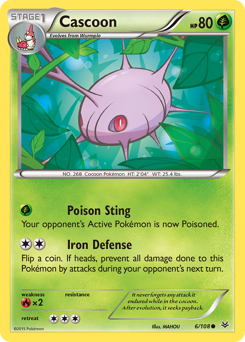
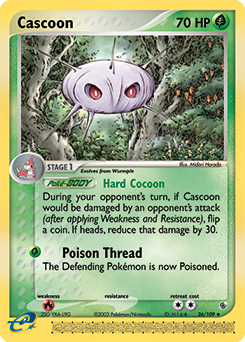
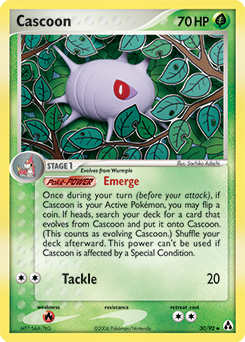
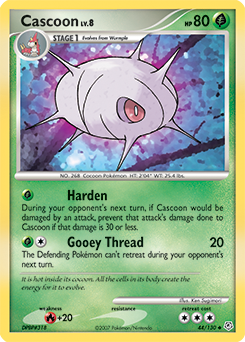
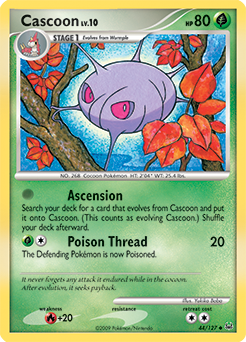
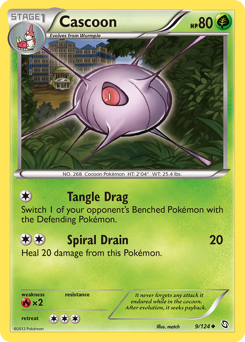
The Exact Evolution Mechanic
Cascoon evolves into  Dustox starting at level 10. This process requires no evolution stones, friendship thresholds, or specific time-of-day conditions. Players simply need to gain experience through standard battles or by consuming Rare Candies.
Because the level requirement is exceptionally low,  Cascoon spends minimal time in your party as a dead slot. In older generations, using the Exp. Share or switch-training against low-level wild Pokemon accelerates this process before the first gym. In modern titles featuring the universal Exp. Share, Cascoon reaches level 10 passively while resting in the back of the party.
Players often search for Cascoon's evolution mechanics when they actually struggle with its pre-evolution.  Wurmple evolves into Cascoon at level 7 based strictly on a hidden, randomly generated Personality Value (PV). If the PV's last decimal digit modulo 10 is greater than or equal to 5, you receive Cascoon. You cannot influence or predict this outcome in-game.
Dustox's Competitive Role & Base Stats
Evolving Cascoon yields Dustox, a Bug/Poison type with a 385 Base Stat Total (BST). This stat distribution heavily favors Special Defense (90) and Defense (70). Its Speed (65) and Special Attack (50) remain severely lacking for any offensive role.
Dustox operates primarily as an early-game wall or a niche Quiver Dance setup sweeper in the lowest competitive tiers. Unlike  Beautifly, which leans offensive, Dustox relies on utility moves like Toxic, Roost, and Whirlwind. Its Shield Dust ability grants immunity to secondary effects from incoming attacks, protecting it from Fake Out flinches or Scald burns.
However, its defensive typing leaves it vulnerable to common Fire, Flying, Rock, and Psychic attacks. In standard competitive formats, Dustox functions as a subpar pivot.  Venomoth performs the exact same Quiver Dance role with significantly higher base stats and the superior Tinted Lens ability.
Pros, Cons, and Competitive Verdict
Evaluating Dustox requires separating early-game utility from late-game viability. It offers a few distinct advantages for playthroughs, but its flaws become glaringly obvious against optimized teams.
- Pros: Access to Quiver Dance and Roost; useful early-game resistances to Fighting and Grass; learns Moonlight for reliable recovery.
- Cons: Abysmal 50 Base Special Attack makes it a passive target; 385 BST is unviable for mid-to-late game; heavily outclassed by Venomoth,
 Scolipede, and
  Amoonguss.
Verdict (2/10): Dustox earns a 2/10 for competitive viability. Evolving Cascoon is necessary for Pokedex completion, but the resulting Pokemon is dead weight in competitive matchmaking. Early-game Nuzlocke runners who need a localized counter to Fighting-type gyms will find temporary value in Dustox. Anyone building a team for post-game battle facilities or Smogon-format competitive ladders should avoid it entirely.
Optimal Moveset Post-Evolution
If you commit to using Dustox after evolving Cascoon, maximizing its utility requires a specific moveset. The standard Quiver Dance set utilizes Black Sludge for passive recovery. This must be paired with a Timid nature and maximum Effort Value (EV) investment in HP and Speed.
Quiver Dance is mandatory to patch up its terrible offensive stats. Sludge Bomb serves as the primary STAB attack, offering a 30% chance to poison the target. Bug Buzz provides secondary STAB to hit Psychic and Dark types effectively.
Roost or Moonlight is essential for longevity. Reliable recovery allows Dustox to accumulate multiple Quiver Dance boosts against passive walls. Without setup, Dustox lacks the raw damage output to threaten even frail opponents.
Generational Changes and Availability
The mechanics of evolving Cascoon remain unchanged since Generation 3, but the experience yields and training methods have shifted. In Pokemon Ruby, Sapphire, and Emerald, players relied on switch-training in the Petalburg Woods. In Pokemon Legends:  Arceus, Cascoon evolves via the manual menu trigger once it hits level 10, rather than automatically after a battle.
As an unofficial fan site, Pokedex.me reminds players that base stat totals and move pools are subject to minor adjustments between generations, though Dustox's core identity as an early-route bug remains static. Its base stat total was slightly buffed in Generation 6, receiving a 10-point increase to Special Defense, but this failed to alter its competitive standing.
EVOLUTION CHAIN




SPRITE GALLERY
 OFFICIAL ARTWORK
 OFFICIAL SHINY
 HOME 3D
 HOME 3D SHINY
 FRONT
FRONT FRONT SHINY
 BACK
BACK BACK SHINY
 ANIMATED
 ANIMATED SHINY
Related Pokémon guides
Pokemon Database
Frequently Asked Questions About Cascoon's Evolution
Why did my Wurmple evolve into Silcoon instead of Cascoon?
Wurmple's evolution is hardcoded to a hidden Personality Value generated when the Pokemon is encountered. You cannot change or predict this value in-game. If it evolves into Silcoon, you must catch another Wurmple and try again.
Does Cascoon need an item to evolve into Dustox?
No. Cascoon evolves entirely based on level progression. Once it reaches level 10, the evolution sequence triggers automatically at the end of the battle, requiring no evolution stones or held items.
Is Dustox better than Beautifly?
Neither Pokemon holds competitive viability, but they serve different roles. Dustox provides better defensive stats and utility moves like Toxic, while Beautifly has higher Special Attack. Dustox is generally preferred in Nuzlocke challenges for its defensive typing.
Can I stop Cascoon from evolving?
Yes. You can press the B button during the evolution animation to cancel it. Alternatively, giving Cascoon an Everstone to hold will prevent the evolution prompt from appearing entirely when it levels up.