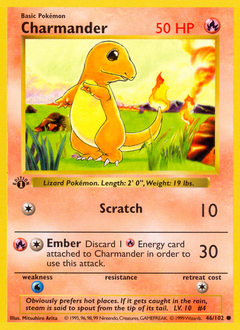
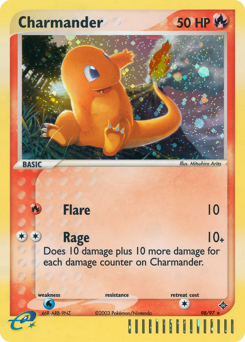
Exact Level Thresholds and EXP Requirements
Charmander operates on the Medium Slow experience group track. This specific EXP curve means it requires a total of 1,059,860 EXP points to reach level 100.
To trigger the first evolution into  Charmeleon, you must reach level 16. This milestone requires exactly 3,138 EXP points, which is easily achievable in the early-game routes by battling standard NPC trainers.
The final evolution into  Charizard occurs at level 36. Hitting this threshold demands an accumulated 35,937 EXP points. No evolutionary stones, trading mechanics, or friendship values are required for any stage of this evolutionary line.
The Strategic Advantage of Delaying Evolution
Pressing the B button during the evolution animation cancels the process. Keeping Charmander unevolved past level 16 provides a distinct mechanical advantage regarding move-pool access.
Unevolved Pokémon learn their level-up moves significantly earlier than their evolved counterparts. For example, Charmander learns Flamethrower—a crucial 90 Base Power STAB move—at level 30.
If you allow the evolution to proceed normally, Charmeleon will not learn Flamethrower until level 34. If you delay learning it until after evolving into Charizard, the move is locked behind level 47, forcing reliance on weaker alternatives like Ember or Fire Fang during the mid-game.
Competitive Verdict: 8/10 Special Sweeper
The evolutionary payoff of raising Charmander is Charizard, a Pokémon we rate an 8/10 in standard competitive formats. Its primary role is either a dedicated Special Sweeper or a Wallbreaker on Sun-oriented teams.
Charizard boasts a base 109 Special Attack and a base 100 Speed tier. This speed allows it to outpace crowded base 95 threats like  Tapu Lele or
  Kyurem, depending on the generation and format.
Its Hidden Ability, Solar Power, multiplies its Special Attack by 1.5x under harsh sunlight. When equipped with Choice Specs and paired with a sun-setter like  Torkoal, Charizard's Fire Blast can reliably 2HKO resistant targets like
  Toxapex.
Pros and Cons of the Charizard Line
Investing the time to evolve Charmander yields specific tactical advantages and severe drawbacks. Understanding these dictates team composition.
- Pro: Exceptional Movepool Coverage. Access to Air Slash, Focus Blast, and Solar Beam provides super-effective coverage against Rock, Water, and Ground-type counters.
- Pro: Sun Synergy. Solar Power transforms it into one of the hardest-hitting special attackers in the game, punishing passive stall teams.
- Con: Extreme Stealth Rock Weakness. The Fire/Flying typing means Charizard loses 50% of its maximum HP upon switching into Stealth Rock.
- Con: Mandatory Item Reliance. Due to the entry hazard weakness, Heavy-Duty Boots are virtually mandatory in singles formats, preventing the use of damage-boosting items like Life Orb.
The base 78 HP, 78 Defense, and 85 Special Defense also leave it highly susceptible to priority moves like Aqua Jet or Extreme Speed.
Who Should Use Charmander?
Charmander and its evolutions belong on highly aggressive offensive teams. Players utilizing weather-control strategies, specifically Drought users, will extract the maximum value from this line.
It is heavily recommended for players who already have dedicated hazard removal on their team. Rapid Spin users like  Great Tusk or
  Excadrill are mandatory partners to keep the field clear for Charizard.
Conversely, stall players or teams lacking pivot support should avoid this evolutionary line. Charizard cannot safely switch into neutral attacks and requires slow U-turn or Teleport support to enter the field unscathed.
Viability in Little Cup (LC) and NFE Formats
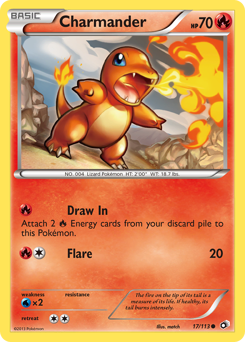
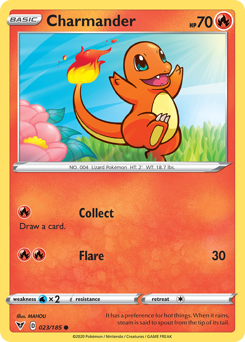
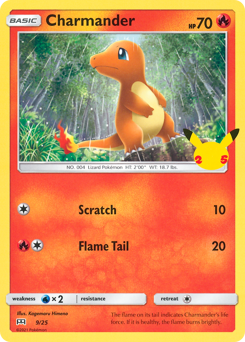
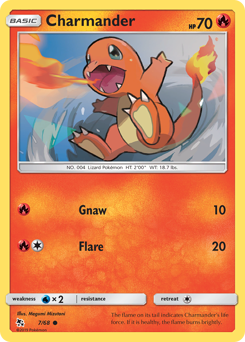
Before evolving, Charmander sees niche usage in the Little Cup (LC) tier. With a base 60 Special Attack and 65 Speed, it functions as a fast Choice Scarf user.
In LC, a Solar Power Charmander under sun support can OHKO most of the unresisted tier with Fire Blast. However, the 1/8th HP recoil from Solar Power combined with Life Orb or hazard damage severely limits its longevity.
Charmeleon, the middle stage, lacks the bulk to utilize Eviolite effectively in Not Fully Evolved (NFE) formats. Its awkward speed tier and lack of reliable recovery make it strictly a transitional phase rather than a competitive asset.
EVOLUTION CHAIN


SPRITE GALLERY
 OFFICIAL ARTWORK
 OFFICIAL SHINY
 HOME 3D
 HOME 3D SHINY
 FRONT
FRONT FRONT SHINY
 BACK
BACK BACK SHINY
 ANIMATED
 ANIMATED SHINY
Related Pokémon guides
Competitive Movesets
Frequently Asked Questions About Charmander's Evolution
Does Charmander need a Fire Stone to evolve?
No. Charmander's evolution is entirely level-based. It does not require a Fire Stone, trading, or high friendship to evolve into Charmeleon or Charizard.
Can you evolve Charmander earlier than level 16?
No. Level 16 is the hard-coded minimum requirement for Charmander to evolve into Charmeleon. EXP Candies or Rare Candies will only trigger the evolution once this level is reached.
What happens if I press B during Charmander's evolution?
Pressing the B button cancels the evolution. Charmander will remain in its base form and will attempt to evolve again the next time it levels up. This is done to learn moves like Flamethrower earlier.
Is Eviolite good on Charmander?
Eviolite boosts Charmander's Defense and Special Defense by 50%. However, due to its low base defensive stats (39 HP / 43 Def / 50 SpD), it remains too frail to function as a defensive wall, making offensive items like Choice Scarf better in LC.