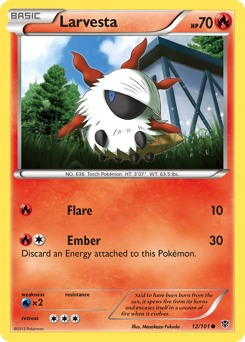
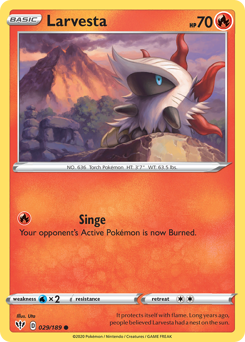
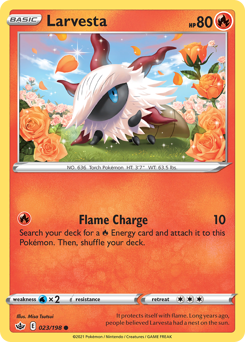
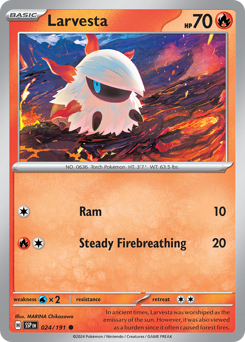
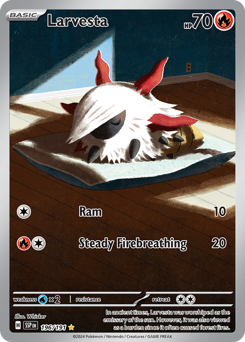
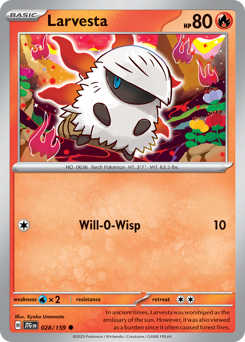
The Level 59 Evolution Threshold
Evolving Larvesta requires reaching level 59. There are no alternative methods, held items, or specific locations that trigger this evolution. This level requirement is one of the highest in the franchise, reflecting its Generation 5 origins where late-game evolution curves were standard.
Because level 59 demands a massive amount of experience points, passive leveling through the standard storyline can be tedious. Players looking to expedite the process should rely on targeted experience farming. In modern generations, feeding  Larvesta Exp. Candies L and XL obtained from high-tier Tera Raids or Max Raid Battles bypasses hours of grinding.
Alternatively, holding a Lucky Egg while chaining  Chansey or
  Blissey encounters remains highly effective. Auto-battling features in Generation 9 also provide steady, albeit slower, passive experience without entering combat screens.
Competitive Verdict: 9/10 Setup Sweeper
 Volcarona operates as a top-tier setup sweeper, earning a solid 9/10 rating in competitive singles. Its entire identity revolves around Quiver Dance, arguably the best setup move in the game. A single use boosts its Special Attack, Special Defense, and Speed by one stage each.
Once positioned correctly, a +1 Volcarona outspeeds the vast majority of the unboosted metagame. Its base 135 Special Attack ensures that neutral targets take devastating damage from its STAB (Same Type Attack Bonus) moves. The Flame Body ability further punishes physical attackers, severely discouraging opponents from using U-turn or priority physical strikes.
This Pokémon is built for Bulky Offense and Hyper Offense teams. It rewards players who can clear entry hazards and create safe entry points against passive defensive Pokémon. However, it requires precise timing; bringing Volcarona in recklessly often results in an immediate knockout due to its subpar base 65 Defense.
Strengths, Weaknesses, and Ideal Teammates
Volcarona's primary strength is its ability to end games single-handedly after a Quiver Dance. Its Bug/Fire typing provides essential resistances to Fairy, Fighting, Grass, and Ice, giving it ample setup opportunities against defensive staples like  Corviknight or
  Amoonguss. Morning Sun offers reliable recovery, allowing it to boost multiple times.
The most glaring weakness is its 4x vulnerability to Stealth Rock. Losing 50% of its maximum HP upon entering the field makes Heavy-Duty Boots an absolute requirement, completely locking its item slot. Furthermore, it struggles against bulky Water-types and Fire-immune Pokémon like  Heatran if it lacks the correct coverage move.
Ideal teammates must provide reliable hazard control.  Great Tusk,
  Iron Treads, or Corviknight are excellent partners that can use Rapid Spin or Defog. Fast pivots that bait in Grass or Steel types with U-turn or Volt Switch can also provide Volcarona with the free turns it needs to initiate a sweep.
Optimizing Volcarona: Movesets and Terastallization
The standard competitive moveset features Quiver Dance, Fiery Dance (or Flamethrower), Bug Buzz, and either Morning Sun or Giga Drain. Fiery Dance is often preferred over Flamethrower for its 50% chance to boost Special Attack, creating a snowball effect during a sweep. Giga Drain provides essential coverage against Water and Rock types while restoring health.
Terastallization drastically improves Volcarona's matchups by shedding its defensive weaknesses. Tera Grass is highly popular, as it flips its Water and Rock weaknesses into resistances while granting STAB to Giga Drain. Tera Ground is a strictly offensive option paired with Tera Blast to instantly eliminate Heatran and  Toxapex.
Tera Fairy offers strong defensive utility, providing an immunity to Dragon and a resistance to Dark, which helps it survive priority Sucker Punches from  Kingambit. The choice of Tera Type should directly address the specific blind spots of your six-Pokémon roster.
Evaluating Larvesta in Little Cup (LC)
While Larvesta is primarily viewed as a stepping stone to Volcarona, it possesses a niche in the Little Cup (LC) format. With a base 85 Attack, it functions as a physical pivot rather than a special attacker. Eviolite boosts its respectable physical bulk, allowing it to utilize Flame Body to spread burns against physical attackers like  Mienfoo.
Its standard LC moveset relies on Flare Blitz for immediate damage, U-turn for momentum, and Morning Sun for longevity. Wild Charge can be slotted to hit Water-types like  Mareanie on the switch. However, Flare Blitz recoil combined with potential entry hazard damage severely limits its lifespan on the field.
Larvesta shares Volcarona's crippling 4x weakness to Stealth Rock. Because Heavy-Duty Boots compete with Eviolite for the item slot, players must choose between surviving hazards or surviving direct hits. This reliance on heavy hazard removal keeps Larvesta from reaching top-tier status in LC, restricting it to specific bulky-offense builds.
EVOLUTION CHAIN

SPRITE GALLERY
 OFFICIAL ARTWORK
 OFFICIAL SHINY
 HOME 3D
 HOME 3D SHINY
 FRONT
FRONT FRONT SHINY
 BACK
BACK BACK SHINY
 ANIMATED
 ANIMATED SHINY
Related Pokémon guides
Competitive Resources
Frequently Asked Questions
Can Larvesta evolve earlier than level 59?
No, level 59 is a hard requirement. While you can catch under-leveled Volcarona in specific Tera Raid battles or wild encounters in certain games, manually evolving Larvesta always requires reaching level 59.
Does Larvesta need a Fire Stone to evolve?
Larvesta does not require a Fire Stone or any other evolution item. It evolves entirely through gaining experience points and leveling up normally.
Why does Larvesta take so long to evolve?
Unova (Generation 5) Pokémon were designed with a late-game progression curve. This resulted in exceptionally high evolution levels for powerful species like Larvesta, Pawniard, and Deino to balance the main story campaign.
What is the fastest way to level Larvesta to 59?
Farming 5-star and 6-star Tera Raids for Exp. Candies L and XL is the most efficient method in modern generations. Alternatively, equipping a Lucky Egg and defeating Chansey or Blissey yields massive experience yields.