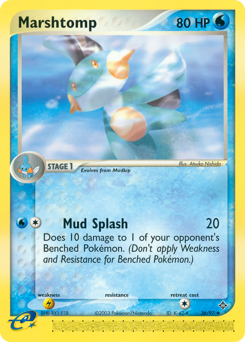
Level 36: The Direct Path to Swampert
To evolve Marshtomp, simply raise its level to 36. The evolution triggers automatically at the end of the battle or upon consuming an EXP-granting item like a Rare Candy.
Unlike many trade-based or item-dependent evolutions,  Marshtomp requires no specific held items, friendship thresholds, or location-based triggers. This straightforward progression makes it highly reliable during standard playthroughs and competitive breeding.
Players looking to accelerate this process can utilize the EXP Share or participate in Max Raid Battles in Generation 8 to farm EXP Candies. Battling higher-level Fire or Rock-type Pokémon yields faster experience while taking advantage of Marshtomp's favorable STAB (Same Type Attack Bonus) matchups.
Swampert's Competitive Role: Bulky Pivot and Stealth Rock Setter
Upon hitting level 36,  Swampert transitions into a premier bulky Water-type. Its base stat total jumps from 405 to 535, with the distribution heavily favoring physical offenses and mixed bulk. The base 110 Attack and 100 HP allow it to trade blows effectively while setting up entry hazards.
In competitive formats like OU (OverUsed) or UU (UnderUsed), Swampert operates best as a defensive pivot. Access to Stealth Rock and Flip Turn lets it control the field and safely bring in fragile sweepers. Because Swampert has a low base 60 Speed, its Flip Turn usually goes last, ensuring the incoming teammate takes zero damage on the switch.
Its Water/Ground typing grants an essential Electric immunity, stopping Volt Switch momentum cold. Grass-type moves are its only vulnerability, meaning it walls a significant portion of the metagame—including prominent Fire, Steel, and Rock types—when positioned correctly.
Mega Swampert: Transitioning to a Rain Sweeper
In formats allowing Mega Evolution, such as National Dex tiers, Swampert shifts from a defensive wall to a terrifying weather sweeper. Equipping the Swampertite allows it to Mega Evolve, boosting its Attack to a staggering base 150 and pushing its bulk to 100/110/110.
Mega Swampert gains the Swift Swim ability, doubling its base 70 Speed in the rain. Under rain conditions set by Drizzle users like  Pelipper, Mega Swampert reaches 278 Speed with zero EV investment, outspeeding base 130 Speed threats like
  Tapu Koko.
Its optimal Mega moveset shifts away from utility. Players typically run Waterfall and Earthquake for raw STAB damage, alongside Ice Punch to punish Grass and Dragon types. A rain-boosted Waterfall from Mega Swampert routinely scores one-hit KOs against neutral targets.
Pros, Cons, and Verdict: Is Swampert Worth the Investment?
Swampert earns a decisive 9/10 rating for both in-game campaigns and competitive utility. It requires minimal team support to function effectively as a tank, though it demands specific weather support to act as a sweeper.
- Electric Immunity: Completely blocks Volt Switch and forces Electric-types to switch out.
- Excellent Bulk: 100/90/90 defenses allow it to survive most neutral hits, including powerful STAB Earthquakes or Close Combats.
- Utility Movepool: Access to Stealth Rock, Roar, Yawn, and Flip Turn provides unmatched role compression.
However, the Pokémon does have notable flaws:
- 4x Grass Weakness: Moves like Energy Ball or Giga Drain guarantee a KO, forcing immediate switches when facing Grass-types.
- Lack of Reliable Recovery: Relying solely on Leftovers limits its longevity against stall teams or hazard-stacking strategies.
For players needing a reliable hazard setter or a bulky physical attacker, evolving Marshtomp is an optimal choice. It struggles only against dedicated Grass-type attackers or teams heavily utilizing Freeze-Dry.
Optimal Movesets and EV Spreads Post-Evolution
Right after evolving at level 36, Swampert gains access to a broader movepool. For a standard defensive build, investing 252 EVs in HP and 252 EVs in Defense with a Relaxed nature maximizes physical bulk. This spread allows Swampert to comfortably check physical attackers like  Garchomp or
  Tyranitar.
Earthquake is its primary Ground-type STAB, providing immediate physical pressure. Waterfall serves as the optimal Water-type STAB, utilizing Swampert's high Attack stat and offering a 20% flinch chance. Stealth Rock is mandatory in 6v6 singles to break Focus Sashes and punish repetitive switching.
Alternatively, an offensive spread of 252 Attack and 252 HP with an Adamant nature turns Swampert into a formidable tank. In this role, Ice Punch becomes the preferred coverage move. It directly targets the Grass-types that threaten Swampert, while also checking Dragon and Flying-types like  Salamence or
  Dragonite.
EVOLUTION CHAIN


SPRITE GALLERY
 OFFICIAL ARTWORK
 OFFICIAL SHINY
 HOME 3D
 HOME 3D SHINY
 FRONT
FRONT FRONT SHINY
 BACK
BACK BACK SHINY
 ANIMATED
 ANIMATED SHINY
Related Pokémon guides
More Evolution Methods
Frequently Asked Questions About Marshtomp
Can I evolve Marshtomp before level 36?
No. Marshtomp cannot evolve into Swampert before level 36 under normal gameplay conditions. You must gain experience through battles, EXP candies, or Rare Candies to reach this specific level threshold.
Does Marshtomp need a Water Stone to evolve?
Marshtomp does not require a Water Stone or any other evolution item. The evolution is entirely level-based. Water Stones are reserved for Pokémon like Staryu, Shellder, and Eevee.
What level does Mudkip evolve into Marshtomp?
Mudkip evolves into Marshtomp at level 16. This early evolution provides a significant advantage in playthroughs, as Marshtomp immediately gains the Ground typing and an immunity to Electric-type attacks.
Should I delay Marshtomp's evolution to learn specific moves?
Delaying evolution allows Marshtomp to learn moves like Earthquake slightly earlier (level 46 instead of level 52 in Generation 3). However, the massive stat boost gained by evolving into Swampert at level 36 usually outweighs the benefit of learning a move early.