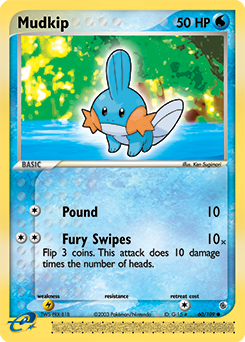
Evolution Mechanics and EXP Requirements
Mudkip evolves into  Marshtomp exactly at level 16. This transition adds the Ground typing to its base Water type, immediately granting an immunity to Electric-type attacks. You do not need any evolutionary stones, friendship thresholds, or trading mechanics to trigger this process.
Marshtomp then evolves into  Swampert at level 36. Both evolutions occur naturally through battle experience, Rare Candies, or the EXP Share item. Holding an Everstone will completely prevent the evolution sequence from triggering until the item is removed from the Pokémon.
Canceling the evolution manually by pressing the B button allows  Mudkip to learn moves like Hydro Pump at level 42 instead of level 51 as Swampert. However, this delays the massive defensive and offensive stat boosts associated with its evolved forms. Disclaimer: Pokedex.me is an unofficial fan-site and is not affiliated with Nintendo or The Pokémon Company.
Mudkip belongs to the Medium Slow experience group. Reaching level 36 requires exactly 41,330 EXP points. Players running through standard campaigns will typically hit this threshold around the sixth gym badge, depending on the generation and party size.
Competitive Verdict: Swampert's Role in the Meta
Swampert earns a solid 9/10 rating for both standard playthroughs and competitive play. Its optimal role in standard formats is a Defensive Pivot or a Stealth Rock Setter. With exceptionally high base HP and balanced defensive stats, it absorbs hits from prominent physical and special attackers across multiple generations.
The Water/Ground typing is mathematically one of the strongest defensive combinations in the franchise. It provides resistances to Fire, Poison, Rock, and Steel, alongside a crucial Electric immunity. This allows Swampert to switch into Volt Switch users like  Magnezone or Rotom-Wash and completely stop their momentum.
Unlike pure passive walls, Swampert also functions as a physical breaker. A high base Attack stat means its Earthquake and Waterfall hit hard even without offensive EV investment. Players heavily utilize Flip Turn, a Water-type pivoting move introduced in Generation 8, to deal chip damage and safely bring in fragile sweepers. This single move solidified its status as a premier pivot in modern competitive brackets.
Pros, Cons, and Ideal Teammates
Swampert is built for players who need a reliable, bulky anchor to absorb hits and set entry hazards early in a match. It is not recommended for hyper-offense teams that require high base speed stats, as Swampert sits at a sluggish base Speed, leaving it outsped by the majority of the unboosted metagame.
The primary flaw in this evolution line is the 4x weakness to Grass-type moves. A single Energy Ball, Giga Drain, or Leaf Storm from a similarly leveled opponent guarantees a One-Hit Knockout. Furthermore, Swampert lacks reliable recovery. Without access to moves like Recover, Roost, or Slack Off, it relies entirely on the Leftovers item or the Rest and Sleep Talk move combination to stay healthy.
To mitigate these structural flaws, competitive players pair Swampert with Flying or Fire-type Pokémon.  Corviknight,
  Skarmory, or
  Talonflame make perfect partners. They resist Grass-type attacks and possess Ground immunities, creating a defensive core that covers Swampert's blind spots while Swampert absorbs the Rock and Electric attacks aimed at them.
Optimal Movesets Post-Evolution
Evolving Mudkip into Swampert unlocks access to a wider physical movepool suited for utility. A standard competitive moveset prioritizes entry hazards and STAB (Same Type Attack Bonus) coverage. Stealth Rock is mandatory on defensive sets, punishing opponent switches and breaking Focus Sashes upon entry.
Earthquake serves as the primary Ground-type STAB, dealing massive damage to Steel, Rock, Fire, and Poison types. Waterfall provides secondary Water-type STAB with a 20% chance to flinch the target. However, Swampert's low base speed rarely allows it to capitalize on this flinch effect unless operating under Trick Room conditions.
The fourth slot typically goes to Flip Turn for momentum, or Ice Punch for coverage. Ice Punch directly threatens Dragon and Flying types like  Dragonite or Landorus-Therian switching in on an anticipated Earthquake. Optimal EV spreads usually maximize physical bulk with 252 HP / 252 Defense / 4 Special Defense, utilizing a Relaxed nature to boost Defense while lowering Speed for slower, safer Flip Turns.
Mega Swampert and Rain Sweeping Mechanics
In Generation 6 (Omega Ruby and Alpha Sapphire) and Generation 7, Swampert gains access to Mega Evolution via the Swampertite held item. This mechanic completely transforms its role from a slow defensive pivot into a highly effective Rain Sweeper. Mega Swampert gains the Swift Swim ability, which explicitly doubles its Speed stat when rainy weather is active on the field.
Upon Mega Evolving, its base Attack receives a massive boost, and its defensive stats increase in both physical and special categories. Under rain, Mega Swampert outspeeds the entire unboosted metagame, including notoriously fast threats like  Dragapult or
  Tapu Koko. Players must pair it with a Drizzle ability user, such as
  Pelipper or
  Politoed, to activate Swift Swim immediately.
A Rain Sweeper moveset drops utility moves like Stealth Rock in favor of maximum offensive pressure. Waterfall becomes the primary attack under rain, which passively boosts Water-type damage by an additional 50%. Ice Punch and Earthquake handle Grass and Dragon resists. Power-Up Punch or Superpower often fills the final slot to break through dedicated physical walls like  Ferrothorn or
  Blissey.
Breeding and Egg Moves for Mudkip
Players looking to optimize their Mudkip for competitive play before evolving it must utilize the breeding mechanics to pass down Egg Moves. Mudkip belongs to the Monster and Water 1 Egg Groups, allowing it to breed with Pokémon like  Slowpoke,
  Lapras, or
  Snorlax to inherit specific attacks.
Curse and Yawn are two of the most critical Egg Moves for a defensive Swampert build. Yawn forces opponent switches by threatening the Sleep status condition, creating setup opportunities for teammates or forcing the opponent to take additional Stealth Rock damage. Curse boosts Attack and Defense while lowering Speed, turning Swampert into a bulky win-condition in late-game scenarios.
To pass down these moves, breed a female Mudkip with a male Pokémon from a compatible Egg Group that already knows the desired move. In Generation 8 onwards, you can also transfer Egg Moves between two Pokémon of the exact same species by leaving them in the Day Care together, provided the receiving Mudkip has an empty move slot.
EVOLUTION CHAIN


SPRITE GALLERY
 OFFICIAL ARTWORK
 OFFICIAL SHINY
 HOME 3D
 HOME 3D SHINY
 FRONT
FRONT FRONT SHINY
 BACK
BACK BACK SHINY
 ANIMATED
 ANIMATED SHINY
Related Pokémon guides
Competitive Movesets
Frequently Asked Questions About Mudkip's Evolution
At what level does Mudkip evolve?
Mudkip evolves into Marshtomp at level 16. It then reaches its final evolution, Swampert, at level 36. Both evolutions happen naturally through battle experience or Rare Candies without the need for evolutionary items or trading.
Can I delay Mudkip's evolution?
Yes, pressing the B button during the evolution screen or holding an Everstone stops the process. Delaying evolution allows Mudkip to learn moves like Hydro Pump much earlier, but you sacrifice the immediate stat increases of Marshtomp.
What is the best nature for Mudkip?
Adamant or Relaxed are the optimal natures. Adamant boosts Attack while lowering Special Attack, perfect for a physical attacker. Relaxed boosts Defense and lowers Speed, ideal for a bulky competitive pivot utilizing the move Flip Turn.
Does Swampert have a Mega Evolution?
Yes, Swampert can Mega Evolve using the Swampertite item in Generations 6 and 7. Mega Swampert gains the Swift Swim ability, doubling its speed in rainy weather and making it a top-tier physical sweeper on rain-focused teams.