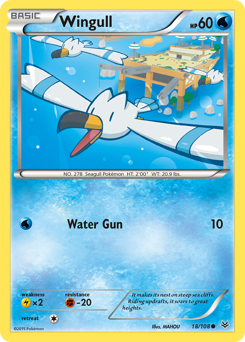
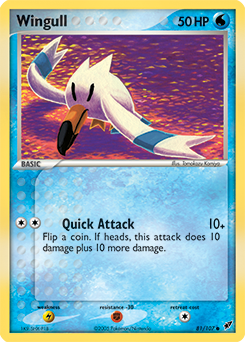
The Evolution Mechanic: Reaching Level 25
Evolving Wingull requires exactly one step: raising it to level 25. You do not need Evolution Stones, trading mechanics, or high friendship values. This level threshold has remained unchanged since the Pokémon's introduction in Generation 3.
Players typically encounter  Wingull at low levels in early-game coastal areas, such as Route 104 in Hoenn or the beaches of Paldea. Simply keeping Wingull in your active party allows it to absorb Exp. Share gains, passively pushing it toward level 25 while you progress through the gym challenge.
If you catch a wild Wingull that is already at level 25 or higher, it will trigger the evolution sequence the very next time it levels up via battle or a Rare Candy. Pressing the B button cancels this animation, though delaying  Pelipper offers no exclusive moves worth keeping Wingull unevolved.
Competitive Verdict & Role Analysis (8.5/10)
Prior to Generation 7, Pelipper was widely considered a bottom-tier Water/Flying type, entirely outclassed by  Gyarados and
  Mantine due to its mediocre base stats. The retroactive addition of the Drizzle ability completely rewrote its competitive viability, elevating it to the OverUsed (OU) tier.
Verdict: 8.5/10. Pelipper is currently the best rain setter in modern competitive Pokémon, functioning primarily as a Defensive Pivot. It reliably sets the weather upon entry, tanks physical hits with its base 100 Defense, and safely brings in frail Swift Swim sweepers.
Unlike  Politoed, which relies purely on raw bulk to survive, Pelipper offers immense utility through a slow U-turn and reliable recovery in Roost. Outside of dedicated weather teams, however, its rating plummets to a 3/10. Its base 65 Speed and average Special Attack simply cannot carry a standalone offensive role in standard team compositions.
Honest Pros and Cons of Evolving
Committing a team slot to Pelipper requires building your entire strategy around its weather control. Analyzing its exact strengths and weaknesses dictates how you pilot the team.
- Pro: Automatic Rain. Drizzle activates immediately upon switch-in, boosting Water-type moves by 50% and allowing Hurricane to bypass its standard 70% accuracy check.
- Pro: Safe Pivoting. A low Speed stat combined with U-turn means Pelipper takes the opponent's attack before switching out, bringing your sweepers onto the field completely unharmed.
- Pro: Longevity. Access to Roost allows Pelipper to heal off chip damage and set the rain multiple times per match, outlasting opposing weather setters like
 Torkoal.
The drawbacks are equally steep. Pelipper suffers a crippling 4x weakness to Electric-type attacks, making it instant setup fodder for prominent threats like  Tapu Koko or
  Raging Bolt. A single Volt Switch often forces Pelipper out immediately.
Furthermore, its Flying typing means it takes 25% of its maximum HP in damage from Stealth Rock every time it enters the field. If your opponent removes Pelipper's Heavy-Duty Boots using Knock Off, its ability to pivot repeatedly is permanently crippled.
Optimal Pelipper Build: Moveset & EV Spread
To maximize Pelipper's effectiveness as a defensive pivot, you must invest heavily in its physical bulk. The standard competitive EV spread utilizes 248 HP and 252 Defense, maximizing its ability to survive neutral physical hits from tier staples like  Great Tusk or Urshifu-Rapid-Strike.
A Relaxed Nature (+Defense, -Speed) is the optimal choice. Actively lowering Speed guarantees your U-turn moves after opposing pivots such as  Corviknight or Landorus-Therian. Winning this "slow pivot" interaction is the cornerstone of generating momentum for rain offense.
The mandatory moveset includes Surf or Scald for consistent STAB damage under rain, punishing Ground and Fire types. Hurricane provides secondary STAB that cannot miss in the rain, specifically targeting Grass-types like  Rillaboom that try to absorb Water moves. Roost and U-turn fill the final two slots to ensure recovery and positional advantage.
Team Synergy: Who Should Use Pelipper?
Pelipper is strictly designed for players piloting Hyper-Offense Rain teams. If your roster features Swift Swim abusers like  Barraskewda,
  Kingdra, or
  Basculegion, Pelipper is a mandatory inclusion to double their Speed and amplify their damage output.
In Generation 9, Pelipper pairs exceptionally well with  Archaludon. The active rain instantly charges Archaludon's Electro Shot, turning a defensive core into an immediate Special Attack threat. Defensive Steel-types like
  Ferrothorn or
  Scizor also benefit heavily, as the rain effectively halves the damage of their critical Fire-type weaknesses.
Do not use Pelipper if you are running Sun (Torkoal), Sand ( Tyranitar), or Snow (Alolan
  Ninetales) cores, as it will actively sabotage your own weather synergy. Similarly, players looking for a standalone bulky Water-type for a balanced team without rain abusers should opt for
  Toxapex or
  Dondozo instead.
Disclaimer: Pokedex.me is an unofficial fan-site and is not affiliated with Nintendo, Game Freak, or The Pokémon Company.
EVOLUTION CHAIN

SPRITE GALLERY
 OFFICIAL ARTWORK
 OFFICIAL SHINY
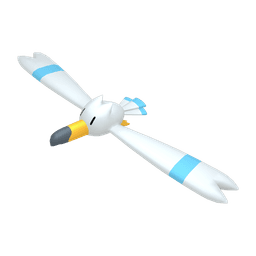 HOME 3D
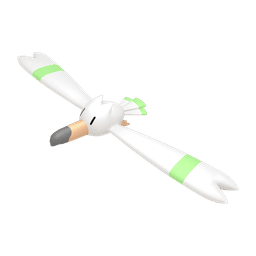 HOME 3D SHINY
 FRONT
FRONT FRONT SHINY
 BACK
BACK BACK SHINY
 ANIMATED
 ANIMATED SHINY
Related Pokémon guides
Competitive Builds & Strategies
Frequently Asked Questions About Wingull's Evolution
What level does Wingull evolve in Pokémon Scarlet and Violet?
Wingull evolves at level 25 in Pokémon Scarlet and Violet, exactly as it does in every other mainline Pokémon game. No specific location, time of day, or Let's Go auto-battle mechanic is required for the evolution to trigger.
Can you evolve Wingull using a Water Stone?
No, Wingull does not respond to a Water Stone or any other evolutionary item. It relies entirely on leveling up through traditional battle experience, Exp. Candies, or Rare Candies to reach the required level 25 threshold.
Does Wingull learn any moves that Pelipper cannot?
Wingull learns exactly the same moves as Pelipper via level-up, just at slightly earlier levels due to being unevolved. There is zero competitive advantage to delaying its evolution past level 25.
Why is Pelipper better than Politoed for rain teams?
Pelipper holds a distinct advantage over Politoed because it has access to reliable HP recovery in Roost and momentum generation via U-turn. Additionally, its secondary Flying typing provides a crucial immunity to Ground-type attacks like Earthquake.