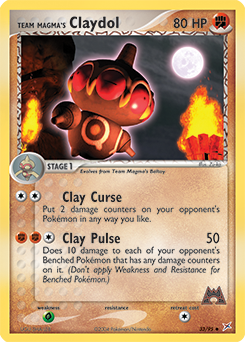
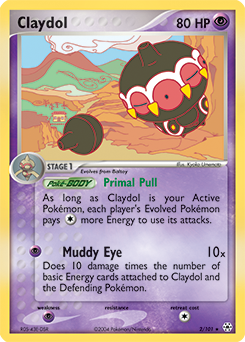
Claydol (In-Game & Casual)
 Claydol is mediocre for most playthroughs and completely unviable in modern competitive play. While its defensive stats and Levitate ability offer excellent bulk, its abysmal offensive output and six elemental weaknesses make it too passive. It functions best as a niche utility wall, but struggles to secure knockouts.
Verdict
Claydol's impressive defenses are entirely undermined by its terrible typing and lack of offensive presence.
Rating 4/10 · Tier C-(In-Game Story) · Role : Utility Wall / Screen Setter
Strengths
- Excellent base Defense and Special Defense
- Levitate provides a crucial Ground immunity
- Deep utility movepool including Rapid Spin, Stealth Rock, and Dual Screens
Weaknesses
- Six common weaknesses (Water, Grass, Ice, Dark, Ghost, Bug)
- Extremely low offensive stats make it a passive liability
- Zero reliable recovery moves outside of Rest
Claydol Base Stats

BEST COUNTERS
Effective Pokémon against claydol


SIZE COMPARISON
SPRITE GALLERY
 OFFICIAL ARTWORK
 OFFICIAL SHINY
 HOME 3D
 HOME 3D SHINY
 FRONT
FRONT FRONT SHINY
 BACK
BACK BACK SHINY
 ANIMATED
 ANIMATED SHINY
Tier & Role: A Passive Utility Wall
Claydol sits firmly in the lower tiers of in-game viability. Its stat distribution heavily favors longevity over damage, making it a dedicated utility wall rather than a traditional attacker.
With base 105 Defense and 120 Special Defense, it can take neutral hits exceptionally well. However, its base 70 in both Attack and Special Attack means it severely lacks the punching power needed to break through opposing teams.
The Power of Levitate
Claydol's saving grace is the Levitate ability. This grants it a total immunity to Ground-type attacks, which is incredibly valuable for pivoting.
Because it is also a Ground-type itself, it naturally resists Rock and is completely immune to Electric attacks. This specific combination of immunities allows Claydol to switch in safely against a variety of physical attackers.
Its movepool reflects its supportive nature. Access to Stealth Rock, Rapid Spin, Light Screen, and Reflect dictates its role: you bring Claydol in to set up field conditions, not to sweep.
Best Uses & Favorable Matchups
Despite its heavy flaws, Claydol shines in very specific defensive scenarios. It excels when used as a pivot to absorb predicted Electric or Ground attacks aimed at your fragile sweepers.
Setting the Stage
In a casual playthrough, Claydol is best utilized as a dedicated setup lead for major boss battles. Equipping it with Light Clay extends the duration of Reflect and Light Screen.
- Dual Screens: Setting up Reflect and Light Screen halves incoming damage for your entire team.
- Safe Healing: Its massive bulk makes it the perfect Pokémon to leave on the field while you use Potions or Revives on your actual damage dealers.
- Hazard Control: Rapid Spin clears away annoying entry hazards if you are playing a ROM hack or a battle facility where the AI uses Spikes.
Claydol completely walls standard Electric-types that lack Ice or Grass coverage. Pokémon like  Jolteon or
  Magnezone struggle immensely to break through its Special Defense and immunities.
In-Game Story Performance
For a standard Pokémon playthrough, Claydol is incredibly frustrating to use. Story modes reward fast, aggressive Pokémon that can quickly one-shot opposing trainers to minimize grinding.
Claydol does the exact opposite. Because its offensive stats are so low, it often requires two or three turns to knock out even basic NPC Pokémon.
The Cosmic Power Trap
Many players fall into the trap of using Cosmic Power to boost Claydol's defenses to unbreakable levels. While fun in theory, this strategy is painfully slow.
Without Toxic to deal residual damage, a fully boosted Claydol still takes forever to win a battle. Earth Power and Psychic simply do not hit hard enough without a boosting item like Life Orb or Choice Specs, which compromises its bulk.
If you are playing a modern Pokémon game with the universal Exp. Share, Claydol will often lag behind your team in usefulness, mostly sitting in the back taking up a slot until you specifically need a wall.
Honest Flaws: Why It Fails
The biggest issue plaguing Claydol is its disastrous typing. Psychic/Ground is a defensive nightmare that leaves it exposed to six common weaknesses: Water, Grass, Ice, Bug, Ghost, and Dark.
In almost every major battle, the opponent will have at least one coverage move that hits Claydol super-effectively. This completely undermines its impressive base defensive stats.
Lack of Reliable Recovery
A wall is only as good as its ability to heal. Claydol has absolutely no access to reliable recovery moves like Recover, Roost, or Shore Up.
- Rest Dependency: The only way Claydol can heal itself is by using Rest, which leaves it asleep and vulnerable for two turns.
- Chip Damage: Because it cannot heal naturally, repeated U-turns, weather damage, and weak super-effective hits will eventually wear it down.
Furthermore, its damage output is so low that opposing Pokémon can often set up Swords Dance or Nasty Plot right in its face without fear of being knocked out.
Avoid If... & Better Alternatives
Do not add Claydol to your team if you prefer a fast, aggressive playstyle. If you want a Ground-type that can tear through gyms quickly, Claydol will only slow you down.
Avoid using Claydol if your team is already weak to Water or Dark-types, as it will only compound those defensive holes.
Superior Alternatives
There are almost always better options available depending on the role you need filled.
 Excadrill: If you need a Ground-type with Rapid Spin, Excadrill is vastly superior. It hits incredibly hard and has a much better defensive typing (Steel/Ground).
 Flygon: If you want a Ground-type with Levitate, Flygon offers much better speed, offensive presence, and a valuable Dragon typing.
 Bronzong: If you specifically need a bulky Psychic-type with Levitate to set up screens or Stealth Rock, Bronzong does the job infinitely better thanks to its incredible Steel typing.
Related Pokémon guides
More Strategy Guides
Common Questions About Claydol
Is Claydol good in competitive PvP?
No. Claydol is unviable in modern competitive formats. Its six weaknesses, lack of recovery, and terrible offensive stats make it dead weight against optimized teams. It sees zero usage in serious ranked play.
What is the best moveset for Claydol in-game?
A standard in-game moveset focuses on STAB and utility: Earth Power, Psychic, Light Screen, and Reflect. If you want a setup approach, you can run Cosmic Power alongside Rest, but be prepared for very slow battles.
What are Claydol's biggest weaknesses?
Claydol is weak to Water, Grass, Ice, Bug, Ghost, and Dark-type attacks. This massive list of common weaknesses makes it very difficult to keep Claydol safely on the field without taking super-effective damage.
Does Claydol have a hidden ability?
No, Claydol does not have a hidden ability. It only has access to Levitate. Fortunately, Levitate is an excellent ability that grants it immunity to Ground-type moves and Spikes.
Pokedex.me is an unofficial fan site, not affiliated with Nintendo, Game Freak or The Pokémon Company. Competitive takes reflect observed usage (Smogon SV stats).