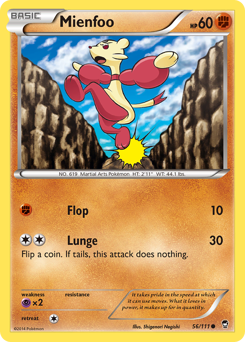
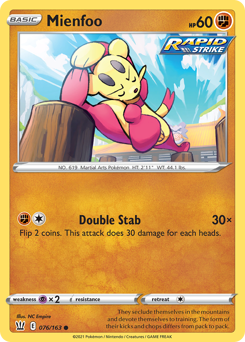
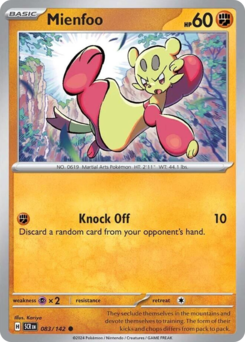
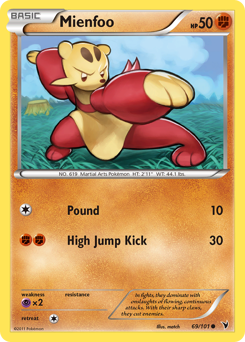
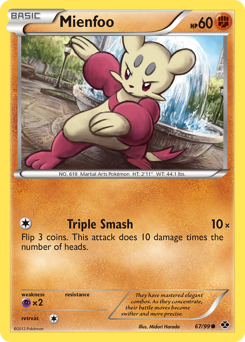
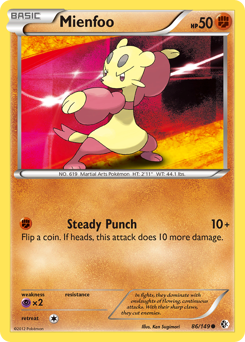
The Level 50 Evolution Threshold
 Mienfoo evolves into
  Mienshao exclusively by reaching level 50. There are no secondary conditions, friendship requirements, or specific times of day involved. Once the experience bar fills and hits level 50, the evolution sequence triggers automatically.
This level requirement is exceptionally high for a first-stage Fighting-type. Most two-stage Fighting Pokémon, such as  Mankey or
  Meditite, evolve in the late 20s or early 30s. Mienfoo shares this delayed progression with other Generation 5 Pokémon like
  Pawniard and
  Rufflet, which were designed for a longer endgame experience in Pokémon Black and White.
Because Mienfoo is often caught at lower levels in earlier routes (or mid-game areas in modern titles like Scarlet and Violet), players face a substantial experience gap. Keeping a first-stage Pokémon in your active party until level 50 demands deliberate resource allocation and team protection.
Surviving the Grind: Eviolite and Positioning
Operating a Mienfoo in the level 40 to 49 range is a mechanical disadvantage. By this stage of any mainline game, opposing trainers utilize fully evolved Pokémon with base stat totals exceeding 500. Mienfoo's base defensive stats (45 HP, 50 Defense, 50 Special Defense) mean it will often be knocked out by a single neutral attack.
To mitigate this liability, Mienfoo must hold an Eviolite. This item boosts the Defense and Special Defense of Pokémon that can still evolve by 50%. While this does not turn Mienfoo into a tank, it prevents rapid OHKOs from incidental damage and allows it to survive long enough to gain active battle experience.
- Lead and Switch: Place Mienfoo at the front of the party and immediately switch it out for a stronger team member to split the EXP.
- Target Weaknesses: Only keep Mienfoo in against slow Rock, Dark, or Normal-types where it can secure a KO with High Jump Kick or Drain Punch.
- Avoid Priority: Keep Mienfoo away from opponents with Fake Out, Extreme Speed, or Aqua Jet, as its frail defenses cannot handle priority physical hits.
Accelerating EXP Gain in Modern Generations
In Pokémon Sword/Shield and Scarlet/Violet, the traditional grind is entirely bypassed using EXP Candies. Engaging in Tera Raid Battles (Gen 9) or Max Raid Battles (Gen 8) yields EXP Candy L and EXP Candy XL. A single EXP Candy XL grants 30,000 experience points.
Feeding Mienfoo approximately four to five EXP Candy XLs will instantly bridge the gap from its typical capture level (around 30-35) directly to level 50. This method bypasses the need for the Eviolite survival strategy entirely.
If playing older generations (Gen 5 to Gen 7), the Lucky Egg is mandatory. Equip the Lucky Egg to Mienfoo to increase all experience gained by 50%. Combine this with the Exp. Share (which functions differently depending on the generation) to passively funnel experience to Mienfoo while your lead Pokémon sweeps through high-level areas like Victory Road.
Competitive Verdict: Mienshao's Role in the Metagame
Evolving Mienfoo into Mienshao yields a strictly offensive pivot. Mienshao is built for a hit-and-run playstyle, defined almost entirely by its access to the Regenerator ability. Regenerator restores 33% of Mienshao's maximum HP every time it switches out, synergizing perfectly with U-turn.
With a base Speed of 105, Mienshao outpaces crowded speed tiers, notably sitting just above  Garchomp (102). It functions as an excellent scout. You bring Mienshao in, threaten a massive Fighting-type STAB move, and use U-turn if the opponent switches to a physical wall. The chip damage from U-turn combined with the healing from Regenerator makes Mienshao incredibly difficult to wear down via entry hazards like Stealth Rock.
- Primary Set: U-turn, High Jump Kick (or Close Combat), Knock Off, and Fake Out.
- Item Synergy: Choice Scarf for speed control, Choice Band for wallbreaking, or Assault Vest for a bulky pivot build.
- Alternative Ability: Reckless boosts moves with recoil (High Jump Kick) by 20%, turning Mienshao into a dedicated wallbreaker, but sacrificing the longevity of Regenerator.
Who Should Use Mienshao (Pros and Cons)
Mienshao belongs on VoltTurn cores and hyper-offensive teams. It pairs perfectly with slow bulky pivots like  Corviknight or Rotom-Wash. The slow pivot takes the hit, bringing Mienshao in safely to threaten the opponent and force a switch.
Do not use Mienshao if your team requires a bulky Fighting-type that can take hits.  Conkeldurr or
  Machamp fill the role of a slow, bulky bruiser much better. Mienshao is a glass cannon; if it fails to secure a KO or pivot out, it will be knocked out by almost any strong STAB attack.
Another significant drawback is its reliance on High Jump Kick. If High Jump Kick misses, or if the opponent switches to a Ghost-type (like  Dragapult or
  Gholdengo), Mienshao loses 50% of its maximum HP to crash damage. While Regenerator recovers some of this upon switching, a poorly timed miss usually costs Mienshao its life.
EVOLUTION CHAIN

SPRITE GALLERY
 OFFICIAL ARTWORK
 OFFICIAL SHINY
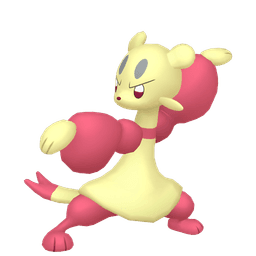 HOME 3D
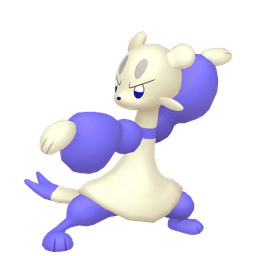 HOME 3D SHINY
 FRONT
FRONT FRONT SHINY
 BACK
BACK BACK SHINY
 ANIMATED
 ANIMATED SHINY
Related Pokémon guides
Explore the Pokedex
Frequently Asked Questions About Mienfoo
Does Mienfoo need a stone to evolve?
No. Mienfoo does not require an Evolution Stone, a specific item, or trading. It evolves into Mienshao strictly by leveling up to 50.
Can Mienfoo evolve earlier in certain games?
No. Mienfoo's evolution level is hardcoded to level 50 across all Pokémon generations. The only way to get a lower-level Mienshao is through specific in-game events or Pokémon GO transfers, which bypass standard leveling mechanics.
Which ability is better for Mienshao: Regenerator or Reckless?
Regenerator is objectively better for most competitive formats. It allows Mienshao to function as a resilient pivot with U-turn, healing off hazard damage. Reckless is only preferred on niche Choice Band sets dedicated purely to wallbreaking with High Jump Kick.
Why does Mienfoo evolve so late?
Mienfoo was introduced in Generation 5 (Black and White), which featured a completely new roster of Pokémon. Game Freak designed the region's progression to stretch into higher levels, resulting in many Unova Pokémon evolving in the 40s and 50s.