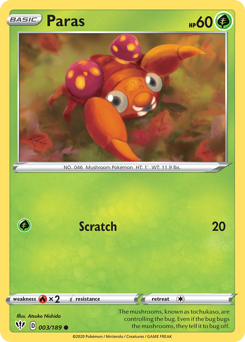
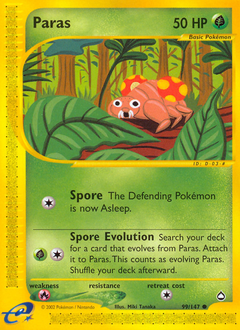
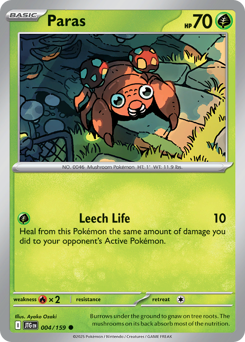
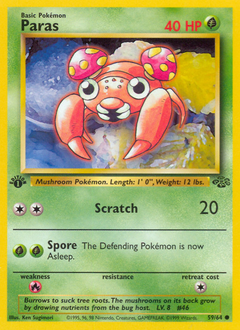
The Evolution Method: Reaching Level 24
 Paras evolves into
  Parasect strictly by reaching level 24. This evolution method remains consistent across all mainline Pokémon games since Generation 1.
Players do not need evolution stones, high friendship, or trading to trigger this process. Accumulating experience points through standard battles, EXP Candies, or the Exp. Share will initiate the evolution screen immediately once level 24 is achieved.
In Pokémon Legends:  Arceus, reaching level 24 unlocks the ability to evolve Paras manually from the party menu. Players must select the glowing Poké Ball icon next to Paras to confirm the evolution and update their Pokédex.
Competitive Verdict: A 3/10 Niche Utility Pivot
Parasect earns a harsh 3/10 competitive rating in standard formats. Its Bug/Grass dual typing is defensively atrocious, saddling it with 4x weaknesses to both Fire and Flying-type attacks.
With a base Speed of 30, Parasect will almost always move last outside of Trick Room conditions. This lack of speed, combined with fragile base 60 HP and base 80 Defense, means it rarely survives neutral hits from modern offensive threats.
Its only viable role is as a niche Trick Room physical breaker or a dedicated Spore utility pivot in lower tiers like ZU or PU. Players looking for a reliable Grass-type pivot are almost always better off using  Amoonguss, which boasts significantly better bulk and a superior Poison/Grass typing.
Ability Analysis: Why Dry Skin is Mandatory
Dry Skin is the only competitively viable ability for Parasect. This ability grants an outright immunity to Water-type moves, healing Parasect for 25% of its maximum HP when hit by one.
Additionally, Dry Skin restores 12.5% of Parasect's maximum HP at the end of every turn during Rain conditions. The trade-off is a 25% increase in damage taken from Fire-type attacks, but since Parasect already faints to any Fire move due to its 4x weakness, this penalty is irrelevant.
Effect Spore offers a 30% chance to inflict Poison, Paralysis, or Sleep on contact, but it is too unreliable for serious play. Damp prevents the use of Explosion and Self-Destruct, a highly situational utility that rarely justifies dropping the Water immunity provided by Dry Skin.
Optimal Moveset: Trick Room Spore Breaker
A Trick Room Spore moveset maximizes Parasect's limited base 95 Attack. The mandatory moves are Spore, for guaranteed sleep on non-Grass targets, and Leech Life, which provides consistent STAB damage while recovering HP.
Seed Bomb serves as the secondary Grass-type STAB, targeting Water and Ground-types effectively. Knock Off is crucial in the final slot to remove Heavy-Duty Boots or Leftovers from defensive switch-ins.
- EVs: 252 HP / 252 Attack / 4 Defense
- Nature: Brave (0 Speed IVs)
- Item: Heavy-Duty Boots or Leftovers
Heavy-Duty Boots is the preferred item to prevent Parasect from taking 25% damage from Stealth Rock upon entering the field. A Brave nature with 0 Speed IVs ensures it moves first under Trick Room.
Nuzlocke Utility and In-Game Playthroughs
Using Paras in a Nuzlocke run requires extreme caution. While early access to Spore at level 22 provides unmatched utility for safely catching wild encounters, its typing makes it a massive liability in major battles.
A random coverage move like Peck or Ember from an opposing trainer will instantly knock out Parasect. As a reminder, Pokedex.me is an unofficial fan-site, and our mechanical analysis consistently ranks Parasect in the lower tiers for deathless runs due to this fragility.
If you must use Parasect in a Nuzlocke, pair it with a Flash Fire Pokémon like  Houndoom to safely pivot out of predicted Fire attacks. Teaching it False Swipe via TM creates an optimal catching Pokémon alongside Spore.
Breeding Mechanics and Egg Moves
Players looking to optimize a bred Paras must focus on specific Egg Moves. Leech Seed can be passed down by breeding Paras with a compatible parent from the Grass Egg Group, such as  Venusaur or
  Roserade.
Wide Guard is available via breeding and offers niche utility in VGC Double Battles to block spread moves like Rock Slide and Heat Wave. Cross Poison is another notable Egg Move, providing coverage against Fairy-types, though it rarely replaces Knock Off in standard sets.
To breed a competitive Paras with 0 Speed IVs, players should attach a Power Anklet to a  Ditto with a 0 Speed IV during the breeding process. This guarantees the offspring inherits the minimum speed required for Trick Room teams.
EVOLUTION CHAIN

SPRITE GALLERY
 OFFICIAL ARTWORK
 OFFICIAL SHINY
 HOME 3D
 HOME 3D SHINY
 FRONT
FRONT FRONT SHINY
 BACK
BACK BACK SHINY
 ANIMATED
 ANIMATED SHINY
Related Pokémon guides
More Bug-Type Strategies
Frequently Asked Questions About Evolving Paras
At what level does Paras evolve into Parasect?
Paras evolves into Parasect starting at level 24. No evolutionary stones, specific times of day, or trading mechanics are required to trigger this evolution.
Is Parasect good in competitive Pokémon?
No, Parasect is heavily outclassed in competitive formats. Its base 30 Speed and 4x weaknesses to Fire and Flying make it a severe liability, though it maintains a minor niche as a Spore user in lower-tier Trick Room teams.
What is the best ability for Parasect?
Dry Skin is the optimal ability for Parasect. It provides a complete immunity to Water-type attacks and heals 25% HP when hit by one, making it an excellent pivot against Water-type Pokémon.
Can Parasect learn Spore?
Yes, Parasect learns Spore, a Grass-type status move with 100% accuracy that puts the target to sleep. In modern generations, Paras learns this move at level 22, just before evolving.